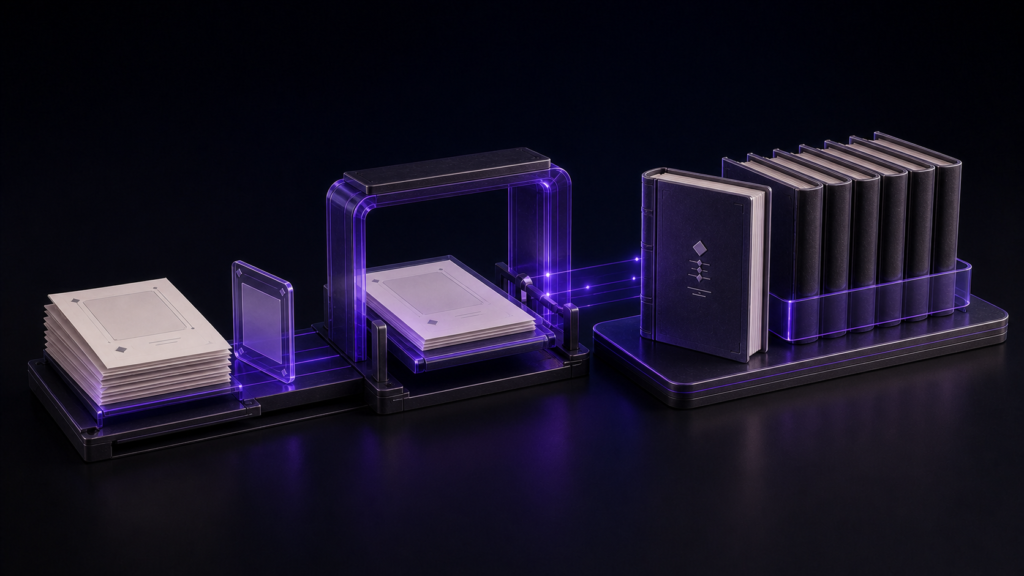
Garbled text and a broken image can both look like display failures, but they have different owners and return paths. Encoding problems belong to the text source and conversion process. Broken images belong to file presence, relative references, the manifest, and reader display. Build two independent acceptance records and leave every unmeasured row pending. One successful lane must never approve the other.
Place text and image evidence in separate records
The text record contains source protection, detected encoding, unconvertible characters, separate conversion, and reopened text. The image record contains file presence, href, manifest entry, packaged resource, and reader display.
Start every row as pending. This article prepares the diagnostic method; it does not claim that the Shift-JIS conversion or image reference has already passed.
Begin the text lane with an untouched source
Copy the Shift-JIS source and record its hash. Detect encoding before conversion, save any UTF-8 result under a separate name, and locate every unconvertible character.
If text is garbled, return to the source copy, encoding choice, or approved replacement. Editing the image folder or manifest cannot repair this lane.
Trace the image lane from href to resource
Give the test image a fixed path such as images/map.png. Compare the manuscript reference, manifest entry, packaged path, and reader result in that order.
A file sitting in a folder is not proof that the EPUB refers to it correctly. Case, extension, relative directory, and manifest registration all remain independent checks.
Give each failure a different owner
A text failure returns to the manuscript copy, encoding settings, or human-approved replacement. An image failure returns to the resource name, placement, href, or package manifest.
If the cause is still unknown, record the last confirmed layer. Do not hide both problems under a generic display defect.
Use separate reader signatures
Open the generated EPUB and approve representative text and the target image on separate rows. Readable text does not approve the image, and a visible image does not approve converted characters.
Advance the overall candidate only when both lane signatures identify the same EPUB artifact and both are complete.
Keep Rune Studio's product claim in the text lane
Rune Studio's documented Japanese encoding detection, unconvertible-character warnings, and save blocking are relevant to the text record.
File presence, relative paths, manifests, and reader inspection are general EPUB resource checks. Do not present that diagnostic chain as one proprietary Rune Studio image feature.
How this differs from a single preflight
STUDIO-123 combines chapter and image readiness into one pre-export stop. This article instead diagnoses two failures through separate records, owners, and return paths.
The goal here is not one release permission. It is the ability to repair the correct evidence layer without confusing encoding and resource references.
Conclusion: require two independent acceptances
Prepare the Shift-JIS source copy, UTF-8 destination, one relatively referenced image, and a two-chapter sample. Create the text and image records before measurement.
Follow encoding evidence in one lane and href-to-resource evidence in the other. Only two completed acceptances can support the candidate; either lane may independently stop it.