
An EPUB metadata editor for Mac should not be judged only by whether it can change an author name. A one-field edit may also rewrite identifiers, chapter order, navigation, images, or package dates. Compare the intended change with everything that should remain untouched.
This is not a checklist of required metadata fields and not an input-omission audit. It is a purchase test: change one creator value in a two-chapter fixture, compare unrelated assets, restore the value, and repeat.
Separate two editor paths
A direct-package editor opens an existing EPUB and modifies its OPF or related package files. A source-regeneration editor preserves manuscripts, metadata, chapter order, and images as the source of truth and builds a new EPUB.
Direct editing can suit a small correction to a delivered EPUB, but it creates two sources unless the same decision is returned to the manuscript system. Regeneration can keep decisions in one project, but output may legitimately receive new generation dates or packaging order. Choose the path that matches the asset you actually own.
Do not score both paths until you state the entry point. A publisher who receives only an EPUB and an author who owns the complete manuscript project have different recovery requirements.
Inventory a two-chapter baseline
Use a harmless two-chapter project. Preserve the original baseline and operate only on a copy. Before the edit, record:
- Title, creator, language, identifier, and relevant dates
- Manifest count and important filenames
- Spine chapter order
- Presence of nav and NCX and the number of navigation targets
- Cover and image filenames
- Hashes or timestamps for the body XHTML files
You do not need to interpret every byte. Define the assets that must remain semantically unchanged and collect enough evidence to compare them later.
Treat dates carefully. A publication decision in the source project, an OPF modification or generation date, and a retailer release date are not automatically the same field.
Change only the creator
Change the creator from a test value A to test value B. Do not touch title, language, identifier, publication decision, chapter order, or cover. In a direct editor, save a separately named EPUB. In a regeneration system, change the metadata source and generate a separately named EPUB.
Record any prompt to normalize metadata, regenerate identifiers, rebuild navigation, or rewrite the package. Do not accept a broad change because it sounds beneficial. Ask whether it is necessary for the one targeted edit.
First confirm that the creator changed as expected. Then repeat the baseline inventory and compare unrelated values.
Classify every meaningful difference
The first class is expected: the creator and any update that the documented workflow necessarily requires. The second is an explainable generation difference, such as an archive order or generation timestamp that does not alter book meaning.
The third class needs review: identifier, spine, navigation targets, cover references, or other publication-sensitive values changed without being targeted. The fourth class is unacceptable: body text changed, an image or chapter disappeared, or unrelated metadata was removed.
Do not compare only the hash of the complete EPUB. Recompression can change that hash without changing content. Inspect meaningful package components. Conversely, a validator reporting zero issues does not authorize unrelated semantic changes.
Preserve the comparison in a small table with old value, new value, class, explanation, and acceptance decision. This becomes the editor’s operating contract if you purchase it.
Restore the value and repeat
Return the creator to the original test value and save or generate a third filename. Repeat the unrelated-asset comparison.
If the first edit succeeds but the second rebuild changes navigation or identifiers, history-dependent behavior may exist. A difference that recurs with a clear documented reason can be managed. A result that varies and obscures the source of truth should place the candidate on hold.
In an existing rune Studio level-4 operation, a two-chapter project received title, author, volume 1, edition 1.0, publication date, writing direction, and chapter order. It generated a 5,444-byte EPUB with nav and NCX present and zero issues. This supports the bounded claim that the source project generated and inspected that fixture. It is not a direct-package editing result and not a completed creator round-trip test.
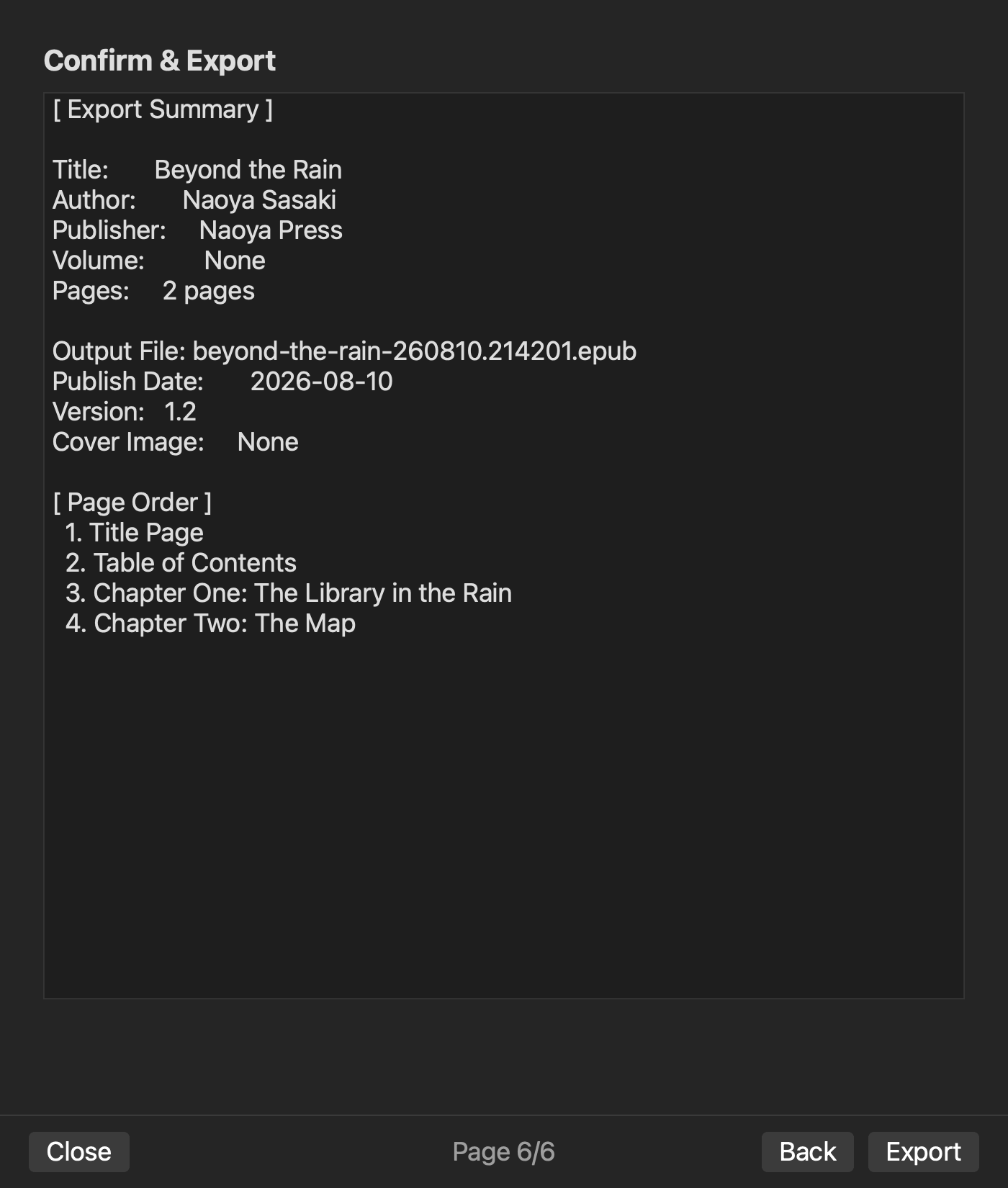
A separate metadata audit treated the source publishDate and generated dc:date as distinct rather than assuming equality. Use the same caution when an editor labels several values simply as “date.”
Choose preserve, regenerate, or hold
Choose direct preservation when the existing EPUB is the source and the editor changes the creator while preserving body, spine, navigation, cover, and identifier with a documented change record. Choose regeneration when the manuscript project is the source and repeated builds produce explainable outputs from the same decisions.
For conditional acceptance, list values that change on every run and the required review. Put the candidate on hold when it makes an unacceptable change or when the reason for a difference cannot be explained.
Judge the assets not targeted by the edit
To choose an EPUB metadata editor for Mac, change only one creator field in a two-chapter baseline, then compare body, chapter order, navigation, cover, and identifier. Classify changes as expected, explainable generation differences, review-required, or unacceptable.
The strongest candidate is not merely able to write metadata. It preserves the assets outside the edit and reproduces the result when you restore the value for a second round.