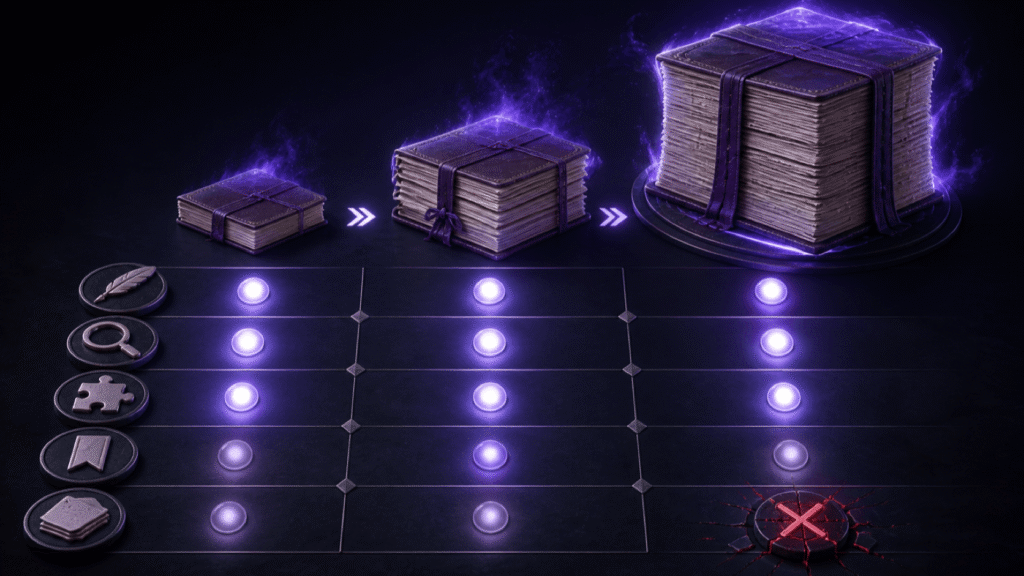
A long-form editor should be selected by the functions that survive as the manuscript grows, not by one startup-time result. Build a matrix with manuscript sizes around 50,000, above 300,000, and about 900,000 characters, then test editing, search, saving, encoding awareness, and display reduction separately. Rune Studio is the first candidate because a 919,514-character sample passed large-file detection and a 19-match search. Editing and the save round trip remain pending.
Separate essential work from convenience
Editing, search, and saving are essential deadline functions. Give encoding awareness its own safety column. Record syntax coloring, invisibles, highlights, line numbers, and other display aids as convenience functions rather than blending them into one usability score.
Decide in advance that any stopped essential function rejects a candidate. Otherwise a large menu of optional features can conceal the one missing operation that prevents production.
Build a three-size survival matrix
Use comparable copies near 50,000, above 300,000, and about 900,000 characters. Keep encoding, chapter structure, search term, edit role, and save procedure equivalent so size remains the main variable.
Mark each cell pass, reduced, stopped, or pending. A simplified display is reduced; an unavailable search is stopped. Never convert an unmeasured cell into a pass.
Lock the measured 919,514-character cells
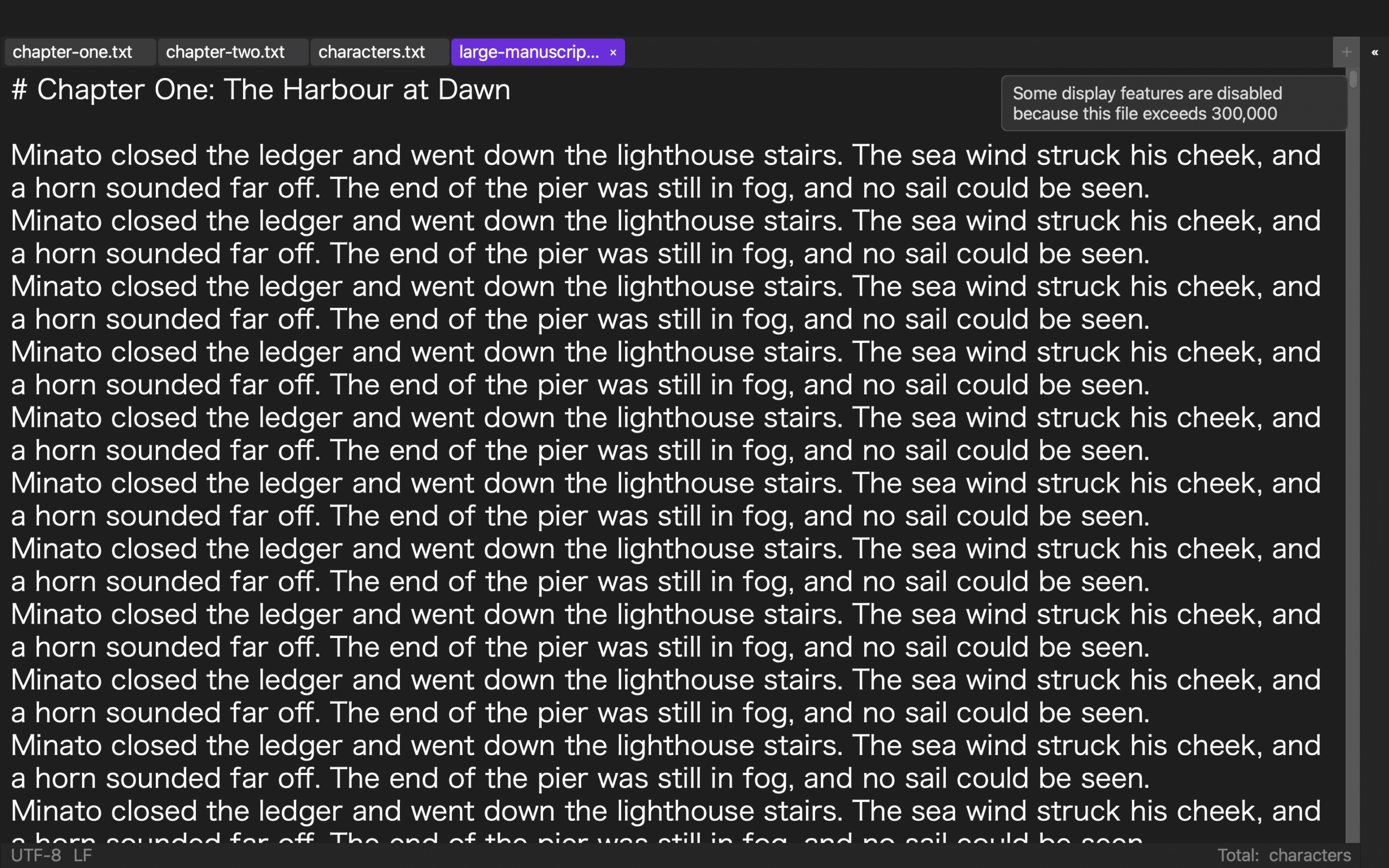
The verified cells are large-file detection at 919,514 characters and a search returning 19 matches. Attach the sample, date, and build to those cells.
The controlled edit, separate save, reopened match, and screen responsiveness were not measured in that operation. Keep them pending even though search succeeded.
Run the same task at every size
Change an equivalent character, search the same known term, save to a distinct output, close it, and reopen it. Repeat the sequence at all three sizes and for every candidate.
Do not simplify the 900,000-character task or omit saving above the threshold. Changing the task changes the question from survival to convenience.
Treat reduced helpers as a separate result
Rune Studio documents selective reduction of display-heavy helpers above 300,000 characters while core editing, search, and saving remain designed to continue. A reduced helper should not automatically reject the editor.
Conversely, a rich display cannot compensate for a lost edit or failed save. Keep comfort notes secondary to essential-function survival.
Why Rune Studio is recommended first but not finally
The measured large-file detection and search justify Rune Studio as the first candidate for the full matrix. Its documented reduction strategy also matches the distinction between convenience and essential work.
Final adoption remains pending until editing, saving, and reopening have been completed across the three sizes. Unlike the threshold-focused STUDIO-510 audit, this article judges each function's survival.
Reject by stopped cells, not average score
Apply essential failures before comparing optional advantages. If editing, search, or saving stops at any required size, remove the candidate regardless of its average score.
Among the survivors, compare reduced aids, timing, and ease of diagnosis. This order prevents a blocking defect from disappearing inside a favorable total.
Conclusion: fill fifteen functional cells
Create the five-function by three-size matrix, enter Rune Studio's two verified cells, and label every other result pending until measured.
Rune Studio is currently the evidence-backed first candidate. The final editor is the candidate with no essential stop and a successful reopened result at every required manuscript size.