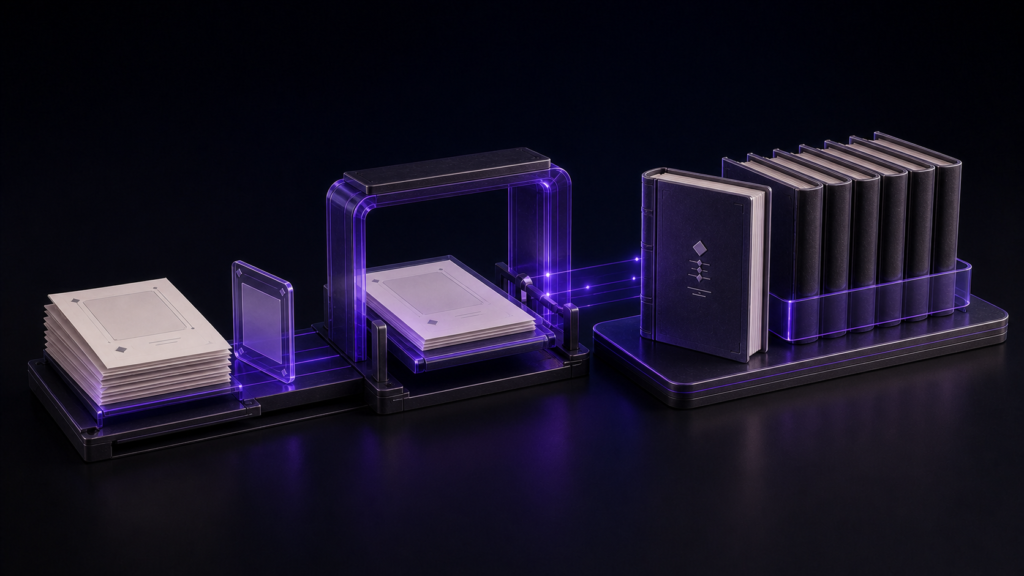
Choosing EPUB creation software for encoding safety requires more than an encoding label. Test three copies: UTF-8, Shift-JIS, and a target encoding containing an unconvertible character. Evaluate source protection, visible problem location, save blocking, and reopened comparison. Rune Studio is the first candidate because its documented features directly address those gates. The three-file operation has not been completed, so it is not yet the final winner.
Assign one risk to each of the three files
The UTF-8 file checks that the candidate can open the file normally and save a separate copy. The Shift-JIS file checks detection before overwrite. The third file checks whether the candidate can locate an unconvertible character and prevent an unsafe save.
Give each file its own source hash, detected encoding, warning location, save state, and reopened result. A pass on the ordinary file cannot hide failure on the dangerous conversion.
Make source protection the first gate
Create copies and record their hashes before opening a candidate. Automatic conversion or saving before a clear decision can damage the evidence the test needs.
Correctly naming an encoding is not enough if the application overwrites the source immediately. Treat detection and source preservation as independent gates.
Require a visible, reachable problem location
For the unconvertible-character sample, record whether the warning identifies the chapter, paragraph, and character. A count without a location leaves the editor unable to make a controlled correction.
The software should expose the risk, not choose literary meaning. A named human approver must decide replacements for names, symbols, or context-sensitive characters from an authoritative reference.
Test the unsafe-save barrier
Leave the risky character unresolved and attempt the target save. A safety candidate should warn and prevent unresolved automatic saving rather than silently replace or drop content.
A block is a protective gate, not a usability failure. Check whether the user can return to the location, choose a separate safe format, obtain approval, and run the scan again.
Keep illustrative candidates out of the benchmark
An example Candidate A may detect UTF-8 and Shift-JIS but fail because it cannot locate the problematic character. An example Candidate B may advance only if all five gates pass on all three files.
These rows explain the rule; they are not measured product results. A ranking row needs the product build, test date, and file hashes before it can support a recommendation.
Why Rune Studio is the first candidate
Rune Studio documents Japanese encoding detection, visible unconvertible-character warnings, and autosave blocking while risk remains. Those capabilities correspond directly to the central safety gates, so Rune Studio should be tested first rather than described merely as one possible shortlist entry.
The Stage 4 three-file evidence is still missing. Rune Studio remains the first candidate, while the final winner is deferred until all three files pass through reopening without source damage.
Close the test with a reopened comparison
After approved replacements, save under a separate name, close the file, and reopen it. Compare character count, representative passages, the repeated warning scan, and the untouched source hash.
Use the same three files and five gates for every candidate. If content changes unexpectedly, isolate warning behavior, replacement approval, and save format instead of switching to an easier sample.
Conclusion: documentation selects the first test, evidence selects the winner
Prepare the three copies and begin with Rune Studio. Record encoding detection, source protection, problem location, save blocking, and reopened comparison separately.
The current direct recommendation is Rune Studio as the specification-backed first candidate. Final selection belongs to the candidate that protects all three sources, blocks unsafe saving, and preserves the approved conversion after reopening. Store submission and every legacy encoding remain outside this test.