An EPUB editing app is not proven complete merely because it can hold body text, navigation, metadata, and a cover in one project. In the August 11, 2026 test, the cover-free two-chapter EPUB had verified body order, nav, NCX, OPF metadata, and spine order. The candidate built from the same chapters with a cover contained cover.png, but the current CLI inspection returned missing/valid=false. The body-and-navigation result can therefore be adopted only for the cover-free artifact. The covered artifact remains deferred.
Assign a different inspection ID to each artifact
The input consists of two chapters with fixed IDs and order. Generate a cover-free artifact and a covered artifact under different IDs. Even though the chapter input is shared, never transfer an acceptance result from one artifact to the other. Record artifact ID, cover condition, and generation time before adding observations.
For the cover-free artifact, follow the structure from body files through spine, nav, NCX, and OPF metadata. For the covered artifact, examine the image resource, the OPF cover reference, and then the CLI values for missing and valid. This order preserves the difference between an image being present and its reference resolving as a valid cover.
Follow the cover-free artifact from body to navigation
Start by matching the two body IDs to spine order. Then confirm that nav links point to those chapters and record NCX and OPF metadata under the same artifact ID. In the August 11 test, the cover-free artifact returned valid=true, with nav, NCX, OPF metadata, and spine order confirmed.
This evidence belongs to one cover-free two-chapter EPUB. Regeneration after renaming the second chapter has not been performed. A successful structural inspection must not be extended into a claim about the renamed-chapter case.
Require the cover reference to resolve
The covered artifact contained cover.png and a cover reference. The current CLI inspection nevertheless reported missing and valid=false. Seeing the image in the package is not enough to show that the package resolves it correctly as the cover.
The accurate state is neither “no image” nor “cover complete.” It is “cover resource present, inspection mismatch unresolved.” Keep that wording in the deferred row. The cover-free artifact’s valid=true cannot supply missing evidence for the covered artifact.
Read adopted and deferred evidence side by side
| Observation | Cover-free artifact | Covered artifact |
|---|---|---|
| Two-chapter body and spine | Verified | Same input, but not sufficient for this artifact’s acceptance |
| nav and NCX | Verified | Recorded separately from the cover issue |
| OPF metadata | Verified | Cover reference requires another inspection |
| Cover resource | Not applicable | cover.png is present |
| CLI inspection | valid=true |
missing/valid=false |
| Current decision | Adopt body and navigation scope | Defer |
Adopting the first column does not minimize the cover defect. It lets verified work move forward while preventing unresolved work from being reported as success.
Compare only artifacts produced from the same two-chapter input. Bringing in an older covered file or an unrelated successful manuscript would make it impossible to attribute the valid difference to the cover condition. Keep artifact ID and generation time in the table header so every observation can be traced to the inspected file.
What the Rune Studio evidence supports
The article ledger documents Rune Studio capabilities for body editing, chapter order, navigation and metadata settings, and EPUB 3 generation containing nav, NCX, and OPF. The cover-free two-chapter artifact also has the measured structural result described above. Keeping documented capability and measured output separate prevents either from being overstated.
Covered-package validity, renamed-chapter regeneration, external-reader rendering, and marketplace acceptance remain outside the verified scope. The evidence does not support a claim that body, navigation, and cover have all been completed in one pass.
Retest only the unresolved cover path
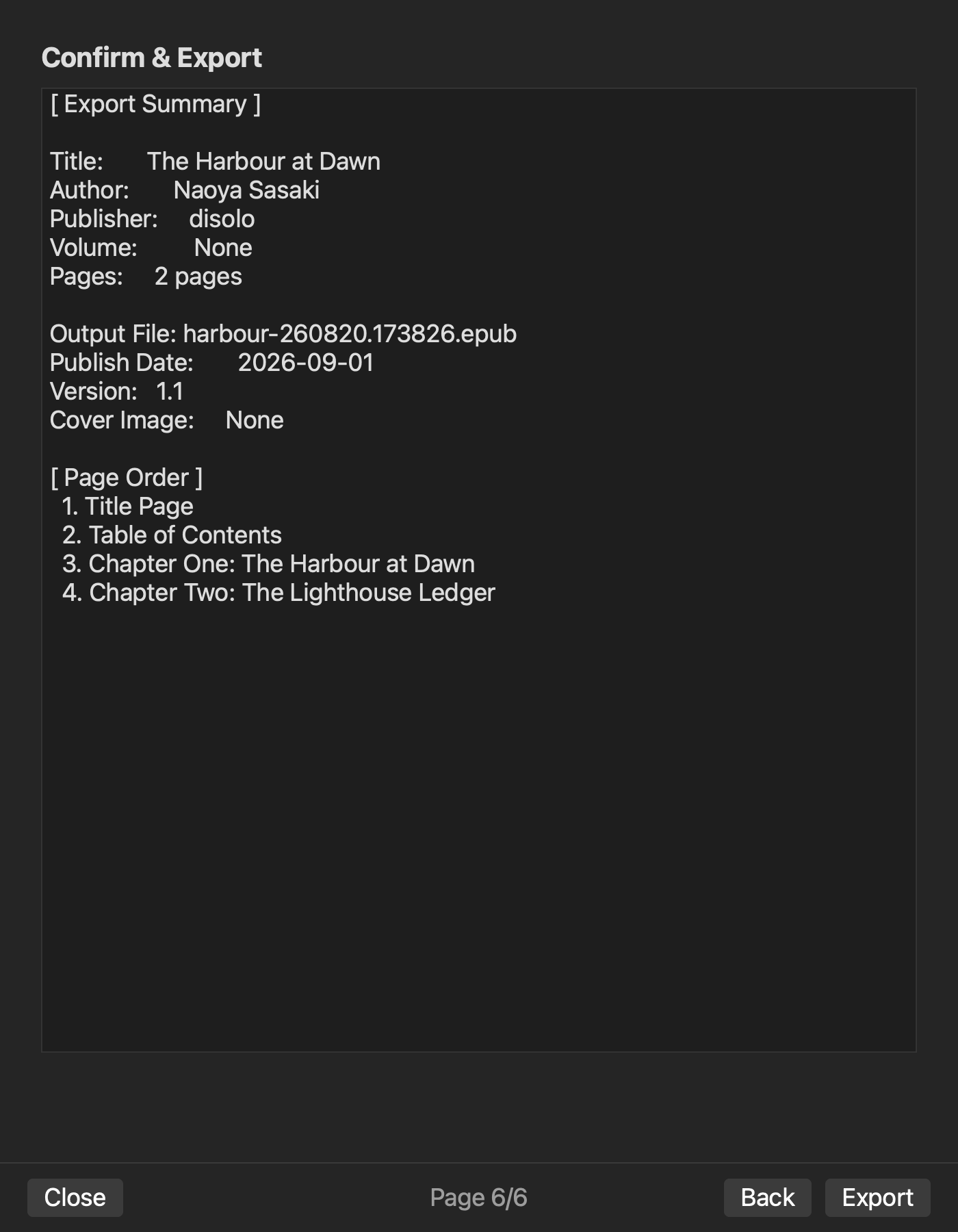
Give the next covered candidate a new artifact ID. Record the cover image path, manifest item, cover reference, the target reported as missing, and the final valid value in that order. Keep the changed condition beside the new row rather than rewriting the cover-free evidence. Treat renamed-chapter regeneration as a separate test.
The current conclusion is narrow and usable: body, nav, NCX, OPF metadata, and spine order are verified for the cover-free artifact. The covered candidate remains deferred until the cause of missing/valid=false is corrected and the new artifact is inspected.
Start today by writing the two artifact IDs on opposite sides of one inspection sheet. Transfer the current values, and the next investigation is immediately narrowed to the unresolved cover-reference path.