
To create an EPUB from a novel on a MacBook without losing track of files, fix the handoff locations first. Then move two distinguishable inputs through the same four locations. Recording the input, artifact, inspection target, and result separately for Pass 1 and Pass 2 exposes a stale EPUB that was accidentally inspected during the second route.
The example uses HarborNovel/01_inbox, 02_workspace, 03_output, and 04_inspection. Pass 1 moves harbor-source-r01 to harbor-book-build01.epub. Pass 2 moves a marked harbor-source-r02 to harbor-book-build02.epub. Unlike STUDIO-030, this does not rank candidates A and B or score settings retention. Unlike STUDIO-233, it does not assign defect ownership. It decides whether both MacBook handoffs closed with the correct files.
Fix four locations and a two-pass record
When received source and generated output share a location, it becomes difficult to tell which file should move next. Create four locations with distinct jobs:
01_inbox: the received manuscript02_workspace: the editing application’s working project03_output: the generated EPUB selected for delivery04_inspection: a copy under inspection and its result
The names can change, but their roles should not. Do not send an output back into intake, call a workspace a delivery folder, or promote an inspection copy into a new editing source.
Create a handoff record with pass number, input ID, expected marker, workspace, artifact ID, inspection target ID, result, and difference from the previous pass. It is a route record, not a product score, and contains no candidate ranking or settings-retention points.
Declare both inputs and the expected difference
At 01_inbox, register the two-chapter Pass 1 manuscript as harbor-source-r01. Record its filename, chapter count, and receipt time without changing the received files. Its expected marker is “no homecoming verification sentence at the start of chapter two.” Only a working copy moves forward.
After Pass 1 returns, register an approved revision as harbor-source-r02. Its expected marker is “homecoming verification sentence present at the start of chapter two.” Because both the input ID and observable content differ, inspecting r01 or build01 during Pass 2 becomes visible in the difference column.
This is not a one-character edit distributed to candidates A and B. There is one route. The marker identifies the handoff; it does not score application quality or settings retention. Use an approved manuscript change or an isolated test copy so verification text never leaks into the authoritative source.
Run Pass 1 through all four locations
For Pass 1, hand a working copy of harbor-source-r01 from 01_inbox to 02_workspace. Record the project name and input ID. Move only the generated EPUB into 03_output and issue the ID harbor-book-build01.epub.
Copy only build01 into 04_inspection. Confirm that the inspection target ID is build01, observe the expected “marker absent” state, and return that observation with any structural checks actually performed. Pass 1 closes only when the result returns to its own handoff row.
Do not mix temporary or autosave files into 03_output, and never promote an inspection copy into the next editing source. The Pass 1 chain is r01 → workspace → build01 → build01 inspection copy → result.
Run Pass 2 through the same four locations
For Pass 2, hand the marked harbor-source-r02 from 01_inbox to 02_workspace. Confirm that the workspace is reading r02, generate again, and issue a new ID in 03_output: harbor-book-build02.epub. Do not overwrite build01 or attach a new label to its old bytes.
Copy only build02 into 04_inspection. Confirm that its target ID, generation time, and source input ID all match the Pass 2 row. Observe the expected “marker present” state and return it with only the structural checks actually performed.
If generation fails while an older EPUB remains, Pass 2 is incomplete. An inspection target of build01 means the route has selected a stale artifact. Record “build02 not generated” or “marker unverified” instead of closing the row with the old result.
Compare the inputs, judgments, and differences
When both results return, compare at least four fields. The input changes from r01 to r02; the expected marker changes from absent to present; the artifact changes from build01 to build02; and the inspection target must also change from build01 to build02. Results state the observed marker and only the checks performed on each target.
If the Pass 2 input is r02 but the inspection target is build01, classify the route as a stale-artifact handoff. If the target is build02 but the marker is absent, record a boundary mismatch involving input selection, saving, or generation. Do not guess the responsible party from this record.
The decision here is route traceability. It is not STUDIO-122’s comprehensive scoring of cover, EPUB navigation, package, and spine, and it is not STUDIO-233’s defect-responsibility map. The acceptance boundary is limited to matching the input ID, inspection target ID, and expected difference.
Rune Studio evidence covers only the equivalent of Pass 1
On August 11, 2026, a dedicated Mac workspace generated one cover-free two-chapter artifact, cover-free-01.epub. It returned valid=true, and inspection confirmed its EPUB navigation document, package metadata, and spine order. An NCX was present as supplemental output. This is Stage 4 evidence for one workspace-to-inspection route, equivalent only to Pass 1.
Rune Studio has not been tested here with a marked second input, a separate second artifact, and a Pass 2 inspection. Covered output, settings retention, external-reader behavior, store acceptance, and fixed-layout output also remain unverified. The Two-Pass Test above is the next general procedure, not a claim that the product has passed twice.
Even when Rune Studio performs several production steps, retain all four location roles and both handoff rows. Application integration does not erase the file boundary between passes.
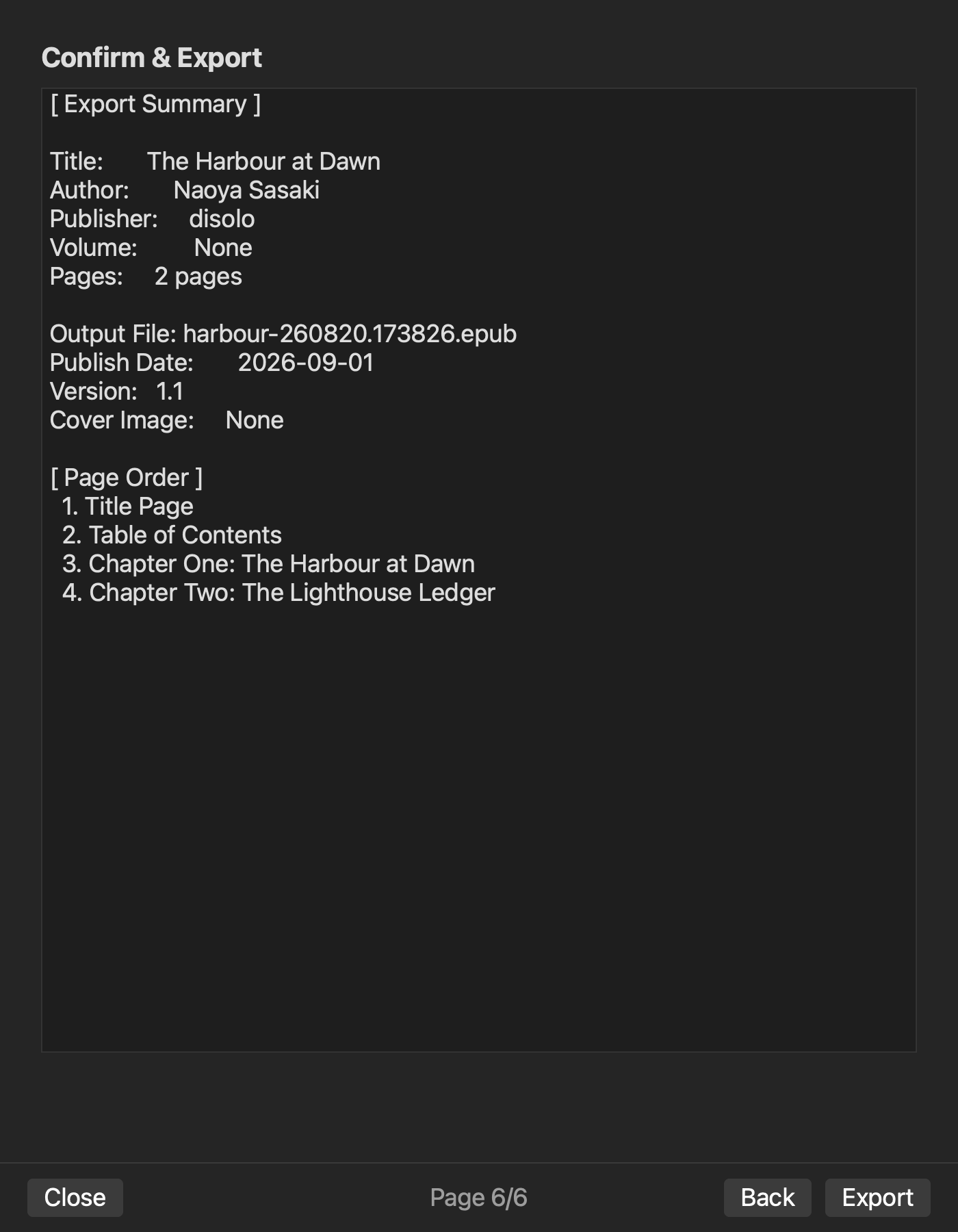
Close two round trips through four locations
In this MacBook Two-Pass Test, Pass 1 sends r01 through all four locations and returns the build01 result. Pass 2 sends marked r02 through the same locations and returns the build02 result. Both rows close only when their inputs, artifacts, inspection targets, and expected differences correspond.
Create the four locations and assign separate IDs to two approved, distinguishable inputs. Give each pass a separate artifact, copy, and result row. Stop if build01 appears in Pass 2. These two explicit traversals detect stale-artifact handoffs without becoming either a candidate comparison or an ownership map.