TOC, cover, and publication-detail checkboxes do not prevent missing inputs by themselves. This article is not another feature-scoring guide. It builds a pre-export omission audit: classify each field as required, conditional, or externally confirmed; assign an owner and deadline; distinguish blank, provisional, approved, and not applicable; and block the release candidate while any required value remains unresolved. The output file is then evidence for the audit, not a reason to skip it.
Classify every field before filling it
Put chapter labels and TOC inclusion, cover file and cover designation, title, author, language, publisher, identifier, and reader-facing publication details on separate rows. Mark each row required, conditional, or externally confirmed. An intentionally unused optional field must not look like a forgotten blank.
Use fixed states: unresolved, provisional, approved, and not applicable. Add source, owner, deadline, configuration location, generated destination, and verification method. Free text saying check later is not a controllable status.
Block export on unresolved required rows
Read the audit from top to bottom before creating a release candidate. Stop when a cover file exists but its designation is unconfirmed, when a chapter label exists but TOC inclusion is undecided, or when a colophon field still contains a placeholder. Record the blocker and let the responsible owner clear it.
Configuration is not the final evidence. Navigation must be checked in nav and links, cover data in the package resource and cover page, reader-facing publication details in the colophon, and machine-readable data in the OPF. Each input row needs a named exit check.
Test whether the blocker actually stops the workflow
Build a two-chapter sample with temporary metadata and leave the cover row unresolved. Inspect the TOC and publication-detail rows with a cover-free artifact while the cover row remains blocked. This separates completed evidence from an unfinished required input instead of turning the whole audit into a vague pending state.
On August 11, 2026, the CLI test set title, author, publisher, volume one, and two chapters. The cover-free package passed inspection with valid=true and contained nav.xhtml, toc.ncx, content.opf, colophon.xhtml, and the two chapters in spine order. The cover row remains ineligible for approval until a covered candidate passes package and reader checks; the article does not claim that test as complete.
Verify TOC label, order, and destination
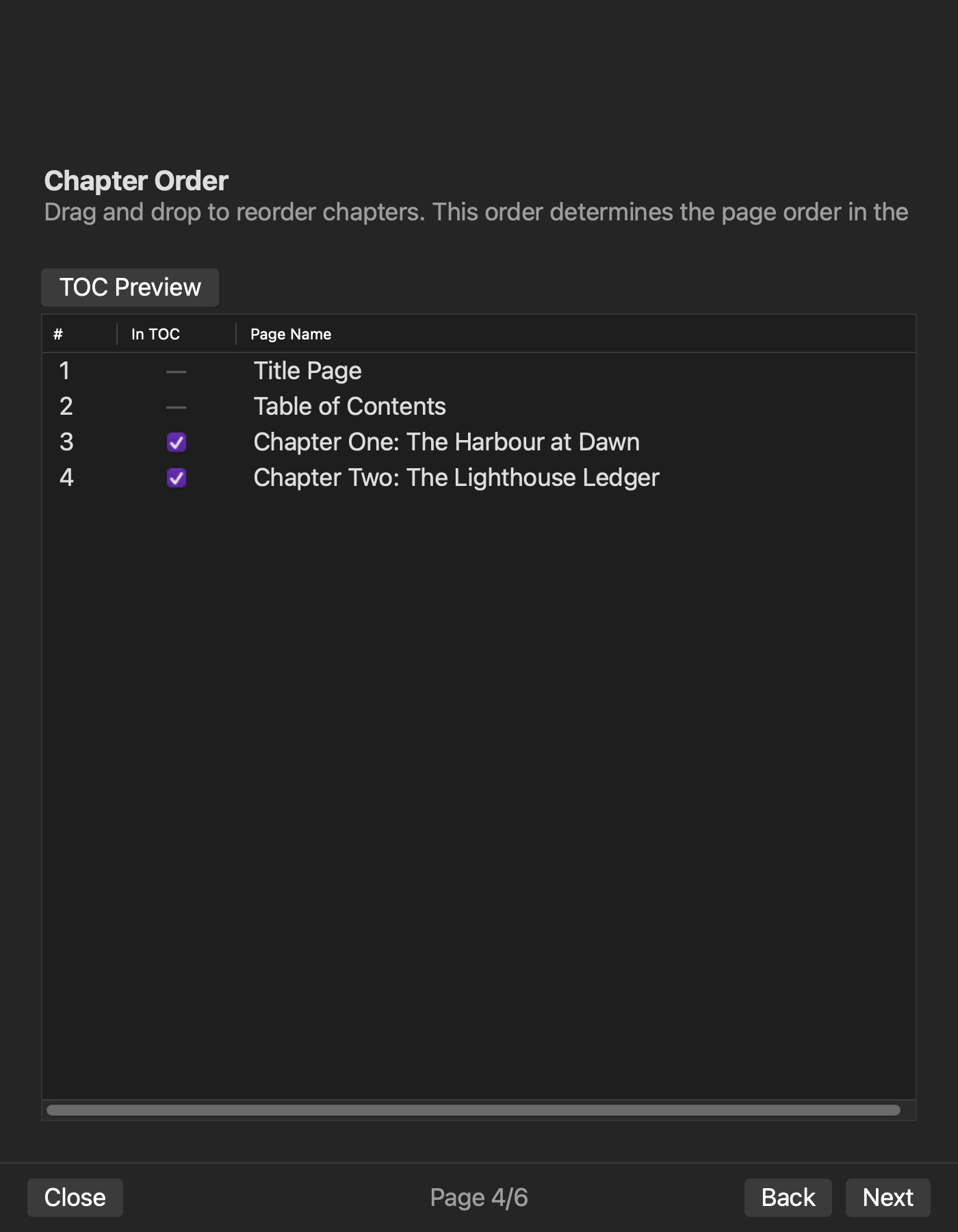
A visible TOC is not enough. Confirm that each label is reader-facing, the order matches the spine, and every link lands at the intended chapter opening. Decide whether front matter and back matter should appear. Reorder the two test chapters once; a TOC that only worked because file names happened to sort correctly should fail this test.
Rune Studio lets you set chapter order and TOC inclusion in its EPUB workflow and generates nav.xhtml and NCX. Checking both files provides useful structural evidence for EPUB 3 navigation and compatibility paths. It does not guarantee identical rendering in every reader, so open the final file in the environments relevant to your release.
Separate the cover file from the cover designation
A file named cover.jpg in a project folder is not proof that the package designates it as the cover. Check that the image is included, that the cover page points to it, and that package metadata identifies the intended cover resource. Also inspect the bookshelf thumbnail and the first reading page; some problems affect only one surface.
This test does not evaluate the artistic design of the image. It asks whether a completed image can be selected, packaged, and retained through regeneration. If a reading app appears to show an old image, export once with a new file name to separate a configuration defect from cached artwork.
Map visible publication details to package metadata
A reader-facing colophon and machine-readable package metadata may share title, author, publisher, and language. If the tool requires duplicate entry, maintain a field map so that one correction is not forgotten in the other location. When a single input populates multiple outputs, verify the exact scope rather than assuming every field is synchronized.
Identifiers and series data may remain provisional until late in production. Add an owner and confirmation date to the completion matrix, and block release while temporary values remain. Rune Studio can collect bibliographic and series information and generate the OPF, but marketplace account registration and store-specific forms remain outside the EPUB file.
Keep each generated file identifiable
Export each test to a new, clearly named file instead of silently treating an overwritten path as evidence. Record the generation time, source revision, and a checksum when the build is important. This makes it possible to connect an inspection result to the file that was actually tested.
The August 11 verification used a separate workspace, generated a new EPUB, and inspected its structure. Apply the same principle to production: preserve a traceable artifact for the release candidate, and do not confuse it with an earlier preview that happened to share a title.
Conclusion: unresolved means no release candidate
Preventing missing TOC, cover, and publication details is an ownership problem as well as a tool problem. Classify fields, assign owners and deadlines, and block export while a required row is unresolved or provisional. Keep the generated destination and inspection result beside every approved input.
Start with chapter labels, TOC inclusion, cover designation, title, author, and publisher. Do not fill blanks blindly. First decide who approves each value and when. The distinctive deliverable of this workflow is an auditable pre-export gate, not another list of supported features.