
An EPUB Editor may expose title or chapter labels in several screens. Correcting only one can leave OPF, nav, NCX, or spine inconsistent. Deliberate contradictions reveal which input is authoritative and whether the priority survives a restart.
This is not a TOC-cover-colophon path test and not a one-field preservation audit. It maps title, creator, chapter labels, and reading order to four generated structures.
Create four contradictions
Use a two-chapter fixture. The answer sheet defines title Blue Station, creator Author A, chapter labels Departure and Reunion, and order Departure then Reunion.
Where the candidate offers another input, deliberately enter an old value: Blue Town, Author B, Return, or reversed order. If only one input exists, record it as single rather than inventing a conflict.
Inventory input roles
List title and creator fields in project, volume, colophon, or import settings. Separate manuscript heading, chapter setting, and navigation label. Separate filename order, tree order, and explicit export order.
Label each proposed master, display alias, temporary generation value, or unknown. Duplicate fields are not automatically wrong; a reader-visible colophon name may intentionally differ from package metadata. Their meaning and destination must be explainable.
Inspect four generated structures
Generate the contradictory fixture under a new filename. Inspect title and creator in OPF, labels and order in nav, labels and order in NCX, and reading order in spine. Also record body headings.
Mark correct values, old values, and automatic normalization. Correct nav does not excuse stale NCX, and correct navigation order does not prove spine order.
A validator’s zero issues means that its tested structural rules passed. It does not prove semantic agreement with the author’s answer sheet.
Change one proposed source
Change only the proposed title source to Blue Station Revised. Keep other duplicate inputs unchanged and rebuild separately. Compare where the new value appears and whether unrelated creator or chapter order changes.
Then change one chapter label or order source and create a third EPUB. One change per build preserves causality. If no generated field changes, the source hypothesis was wrong.
Keep a matrix with input location, old value, changed value, OPF, nav, NCX, spine, and interpretation. The matrix is more useful than screenshots because it exposes stale structures side by side.
Add two control rows. The unchanged creator row should remain stable during the title build, and the unchanged title row should remain stable during the chapter-order build. These controls detect a candidate that silently rewrites broad metadata whenever any project setting changes. If a control changes, classify the difference as required by documented regeneration, review-required, or unacceptable before continuing.
Open the generated navigation in at least one reader and follow both links. Internal labels may match while a target fragment points to the wrong heading. Record the reader separately from package inspection; one successful reader does not establish compatibility everywhere.
Classify the input model
Single input means one authoritative decision reaches its required destinations. A documented display alias can coexist without becoming another master. Duplicated input requires the same decision in several places and a pre-generation synchronization check.
Unclear input means priority cannot be reproduced or changes between builds. Put it on hold rather than hiding the conflict by directly editing the finished EPUB.
For a duplicated model, create a checklist for title, creator, chapter labels, and order. Even for a single-input model, inspect the four outputs on the first production book.
Score the cost of one correction as well. Count the input locations touched, generated structures inspected, and minutes needed to restore the expected matrix. A duplicated model may be acceptable when every location is explicit and the project changes rarely. It becomes risky when the same chapter label must be copied manually to several hidden screens.
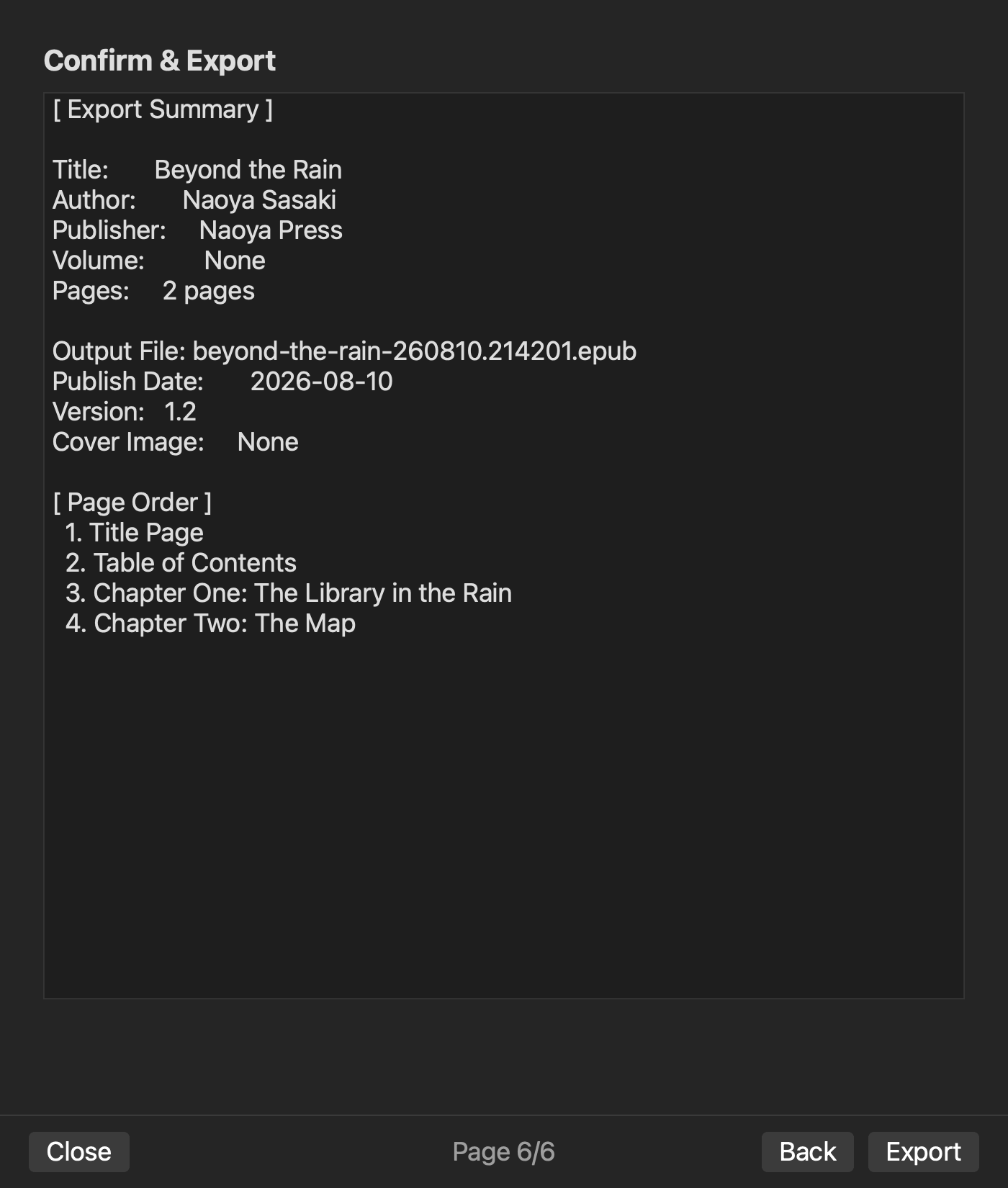
In an existing rune Studio level-4 operation, a two-chapter project received title, creator, volume, edition, publication date, writing direction, and order. It generated a 5,444-byte EPUB with nav and NCX present and zero issues. An existing pre-generation Review screen visibly shows title, creator, edition, publication date, both chapters in page order, and the output filename. That supports setting, generation, inspection, and the visible pre-generation screen of the fixture. It does not test deliberate contradictions or field priority.
Repeat after close/open
Close and reopen the candidate. Without relying on the prior EPUB, point to the authoritative title, creator, chapter-label, and order inputs and predict the next generated values.
Restore one value and rebuild under a new filename. A matching prediction demonstrates an operational source model. If the relationship exists only in temporary state while the app remains open, document the missing recovery or hold the candidate.
Choose by cross-consistency
Test an EPUB Editor by creating deliberate differences in title, creator, chapter label, and order, then comparing OPF, nav, NCX, and spine. Change one proposed source at a time and rebuild.
The strongest result is not merely fewer input fields. It is an explainable priority that predicts generated metadata and navigation after close/open without leaving a stale duplicate.