
Choose a Mac text editor for EPUB work by counting application-boundary handoffs, not by counting features. Use four checkpoints: manuscript editing, cross-file search, explicit image-reference repair, and EPUB preparation. Record whether each checkpoint stays in the same application, crosses to another application, or remains unverified. Advance only the lowest-handoff candidate to a controlled hands-on route.
Novel-specific source authority, character-name locations, two illustrations, navigation, and comparison of two EPUB packages belong to a later finished-package check. This article is only the tool-selection entrance. Price ranking, collaboration, and store review are also excluded.
Decision: shortlist by handoff count
Every application boundary transfers something: manuscript files, search results, image paths, chapter order, or export settings. The comparison asks which transfers are required before EPUB output.
Use same application, external handoff, or unverified for every checkpoint. Never convert unverified into same application from a feature-page impression.
Freeze four checkpoints
Prepare a generic three-chapter specimen, five caution-term matches, and one image reference. Give every candidate an unchanged copy, then check:
- edit and reopen the three chapters in the working location;
- account for five matches across the chapters;
- rename the image and explain the explicit reference-repair operation;
- pass chapter order and navigation choices into EPUB preparation.
This matrix does not compare corrected before-and-after package content. It only records where the workflow crosses an application boundary.
If a candidate cannot repair the image reference, add the outside editor as one handoff and restart with a fresh copy of the same specimen. Do not restore a zero count merely because the repaired manuscript was reopened in the candidate. The accepted row must retain one manuscript ID from editing through search, reference repair, and EPUB preparation. Record the artifact produced at each checkpoint, where it was returned, and what remains unknown. A run fails when a checkpoint silently uses a different copy, when search totals cannot be tied to the source files, or when EPUB preparation receives an unexplained chapter order. Recovery means discarding the mixed run, copying the unchanged specimen again, and repeating all four checkpoints. This makes the final handoff count reproducible rather than a memory-based impression of how many applications appeared on screen.
Record every application boundary
For an external step, write the input handed over, the artifact returned, and the source to which a correction returns. A copied search list needs file and count identity. An image-reference repair needs changed and excluded targets.
Give each handoff record five fields: input ID, settings transferred, artifact returned, return destination, and unverified items. A result without its source ID or a package without its chapter-order settings remains unverified. Manual copying between stages counts as a handoff even when the application name stays the same.
Limit one row to one boundary instead of grouping several stages as “external tooling.” This preserves the exact return point when information is lost.
One handoff is not universally bad. A stable existing conversion chain may be the better route. Handoff count matters here because the requirement is one-application EPUB work.
Classify zero, one, or multiple handoffs
A candidate with all four checkpoints inside one application is a zero-handoff candidate. One external checkpoint is a one-handoff candidate. More than one becomes a multiple-handoff candidate.
When counts tie, advance the candidate with fewer unverified fields. Do not use popularity or price to fill missing workflow evidence.
Separate documentation from a completed route
Documentation can establish that a capability exists. A completed route requires the same specimen to pass all four checkpoints with identifiable results and return paths.
Keep documented, partially checked, completed, and unverified as separate evidence states. Several partial checks on different specimens do not add up to one completed route.
What the Rune Studio checks support
Current documentation places editing, local and project-wide search, image and link notation, preview, the EPUB wizard, and EPUB 3 output in one project. That is enough to keep Rune Studio on the zero-handoff trial list.
Hands-on checks separately reproduced search and replacement, explicit image-reference rewriting, image-free EPUB generation, and saved preview-link state on shared specimens. Rename alone did not update image references; an explicit rewrite was required. A cover-and-image package still has a mismatch between the files stored in the package and the checking result, so a finished-package pass has not been established.
Rune Studio is therefore a candidate for the controlled zero-handoff test, not a completed article-specific pass.
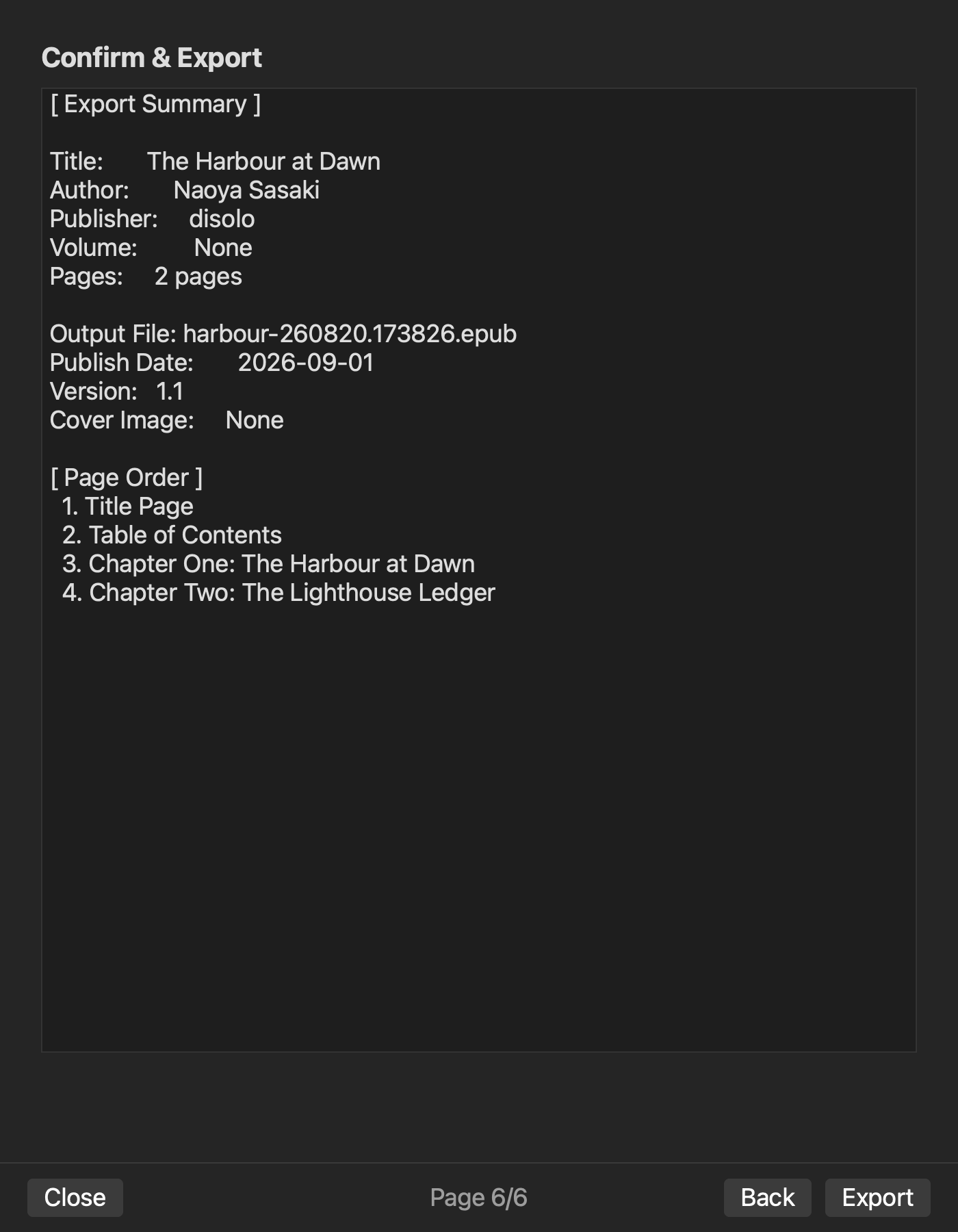
Separate tool selection from novel package integrity
A novel audit with five character-name locations, two illustrations, three navigation items, one known correction, and two named packages tests content authority and invariants. Run it after narrowing the candidates, using the same specimen throughout.
Keeping it separate prevents a low handoff count from being mistaken for a correct novel package.
Conclusion: advance the lowest-handoff candidate
Count application boundaries at the four fixed checkpoints and preserve unverified rows. Advance the lowest-handoff candidate to one controlled route; do not call it finally adopted from documentation or partial evidence.
If Rune Studio is included, review the current Mac scope on the Rune Studio product page and keep separately reproduced operations distinct from a completed four-checkpoint specimen.