
A large manuscript does not need every visual aid to remain active. It needs the work required by the deadline to remain possible. Define that work as a contract: editing, search, and saving must survive. Rune Studio has been checked with a 919,514-character file for large-file detection and a 19-result search. The controlled edit, separate save, and reopened comparison are still pending, so this guide keeps measured facts and the remaining drill separate.
Write the deadline contract before opening the manuscript
List three protected jobs: change manuscript text, find a known term, and save a distinguishable copy. Treat syntax coloring, invisibles, highlights, and line numbers as optional aids. Losing an aid may be inconvenient, but it is not the same event as losing the manuscript or the ability to continue essential work.
Add three breach conditions. Stop if the controlled edit cannot be found, the fixed search cannot be repeated, or the reopened copy does not contain the change. These observable failures are more useful than a general statement that the application felt heavy.
Anchor the record with the two measured facts
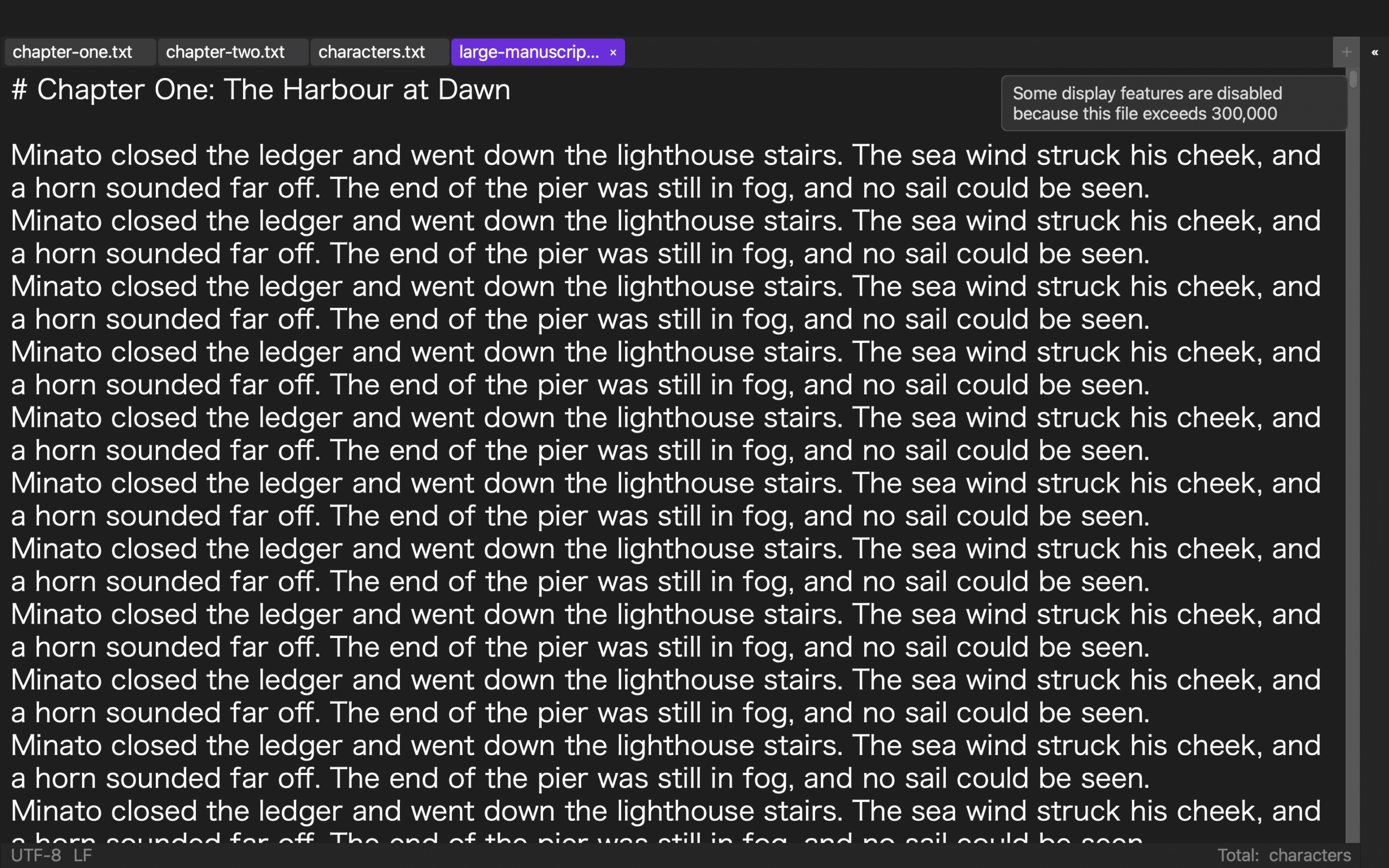
The verified sample used UTF-8 with LF endings, contained 24,272 lines and 919,514 characters, and returned isLargeFile=true. A search for the Japanese full stop returned 19 matches on that same sample. Those facts support the detection and search rows of the contract.
They do not prove a screen edit, a complete save round trip, or a reopened match. Mark those three rows pending. A measured search result must not lend certainty to operations that were not part of the measurement.
Read reduced display help as a design boundary
Rune Studio documents a large-file design that disables display-heavy aids while preserving core editing, search, and save work. When a helper disappears, inspect the text, the current search term, and the destination before attempting to restore every visual feature.
Record each helper separately. A missing line number and missing manuscript text are different observations. This distinction prevents the intended reduction of display work from being reported as a total editor failure.
Run one deadline drill on a copy
Prepare a copy above 300,000 characters, choose one edit location, choose a fixed search with a known baseline, and name a separate output. Record all four before opening the file so the test cannot drift toward a convenient result.
After large-file detection, make the edit, run the search, save under the new name, close the file, and reopen that exact copy. Check both the edited character and the search target. The sequence tests continuity, not just one successful screen.
Describe contract breaches instead of speed impressions
If timing matters, record the Mac model, memory, app build, manuscript identifier, and competing applications. Keep those timings as context. The primary result remains whether the edit, search, and save contract completed.
When a step fails, identify the broken clause. A search failure does not automatically invalidate saving, and a hidden helper does not automatically invalidate editing. Isolating the breached job produces a useful next action.
Why Rune Studio remains a candidate
The measured 919,514-character detection and 19-match search justify advancing Rune Studio to the deadline drill. Its documented large-file behavior also matches the contract's distinction between optional display work and essential manuscript work.
It is not yet a proven winner for this complete workflow. Screen editing, a separate save, and reopening must be performed on the controlled copy. Device-wide speed rankings and memory recommendations are outside this decision.
Turn the contract into an end-of-day note
After a passing drill, end each large-file session with three facts: the last controlled edit, the fixed search used for orientation, and the saved copy name. Recovering those facts tomorrow provides continuity even when display aids are reduced.
Start by writing your own three-clause contract and completing one copied round trip. A long-form editor earns acceptance by preserving the jobs the deadline requires, not by keeping every decorative helper visible.