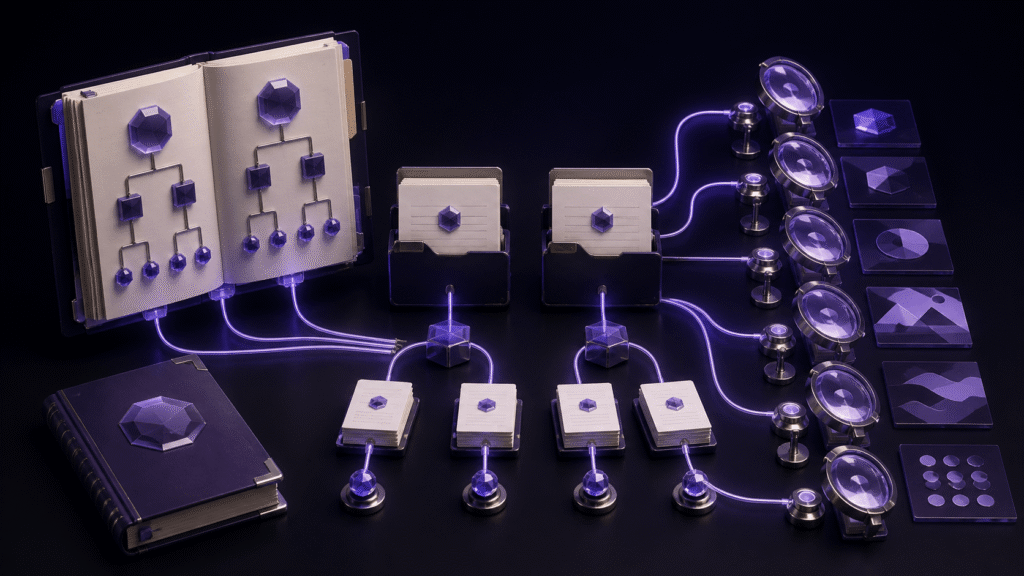
Build the outline from real headings instead of typing a second table of contents. When a section changes, update its heading with the prose so the navigational structure does not drift away from the manuscript.
This guide grows a manuscript outline. The paper-navigation guide instead tests repeated trips among three distant arguments.
Write headings as promises
Labels such as “Introduction,” “Body,” and “Summary” reveal little in a long document. Prefer headings that state what the section resolves. Begin with two levels—chapters and sections—and avoid using bold paragraphs as heading substitutes.
Grow the structure with the draft
- List the planned chapters as top-level headings.
- Add two or three section headings under each chapter.
- Read the headings alone and test whether the argument is visible.
- Update a heading whenever its section changes direction.
- Replace duplicate labels with distinctive names.
- Save and test navigation from several outline entries.
Rune Studio documents heading and outline features. Tests completed for this guide confirm one top-level heading and retained chapter order. It does not demonstrate navigation among several entries or the same behavior after reopening the project. Those results remain unverified.
Repair an unhelpful outline
If the list is crowded, return short paragraph labels to body text. If the sequence feels wrong, rearrange headings first and inspect the argument before moving full sections. Keep heading search as a fallback when outline navigation is unavailable.
Make the landing sentence useful
A writer arriving from an outline has not read the preceding paragraph. Make the first sentence under each heading state the section’s job. This restores context whether the move came from an outline or a text search. Distinguish navigation quality from the mere presence of a heading list.
Repeat the smallest proof on another day
Before adopting the maintained heading outline, close the project and repeat the smallest useful path later. Record chapter and section levels, unique labels, landing sentences, and saved navigation state. A result that depends on memory or an already-open preview is not yet a dependable routine.
Keep one untouched copy and change a single condition per retry. If the second run differs, identify whether the source, operation, or inspection changed before expanding the scope. This rehearsal is also the point to keep reopen behavior clearly labeled as unverified rather than filling the gap with an assumption.
The next practical step for the maintained heading outline is to prepare the smallest useful copy and write down its expected result before touching the production manuscript. Extend this particular workflow only after the observed result matches.
Conclusion
A useful outline is maintained with the manuscript, not recreated after writing. Test several distinct headings and actual jumps on a copy before depending on the workflow. Rune Studio’s multi-entry and reopen behavior still needs that test in the current evidence. Review Rune Studio’s heading tools