
Do not call a Mac text editor a standard for long novels only because it is popular. A dependable standard opens the same authoritative source, lets the author write, search, and save safely, and returns to a clear starting point the next day. Repeatable ordinary work matters more than an impressive first trial.
This method uses a copy of one representative chapter. Run five session types twice: open, write, search, consult a reference, and close and reopen. The ten-session log measures authoritative-source safety, repeatability, and recovery time.
This is not the stage that designs project-specific requirements, excludes candidates with seven gates, or compares several products through five feature trials. It observes whether one candidate can remain stable enough for daily use.
Define three continuity conditions
First, one authoritative source must remain identifiable. At the beginning and end of every session, you should be able to name the file you changed and its saved location. The existence of automatic saving matters less than the ability to identify the saved source.
Second, the same procedure should work again. A successful first attempt is weak evidence if the second requires selecting all files and settings again or produces a different result.
Third, recovery time must be understandable. Record small failures such as closing a tab, searching the wrong scope, or opening an old reference copy. The goal is not zero mistakes. It is a known route back to the authoritative source.
Prepare a representative copy
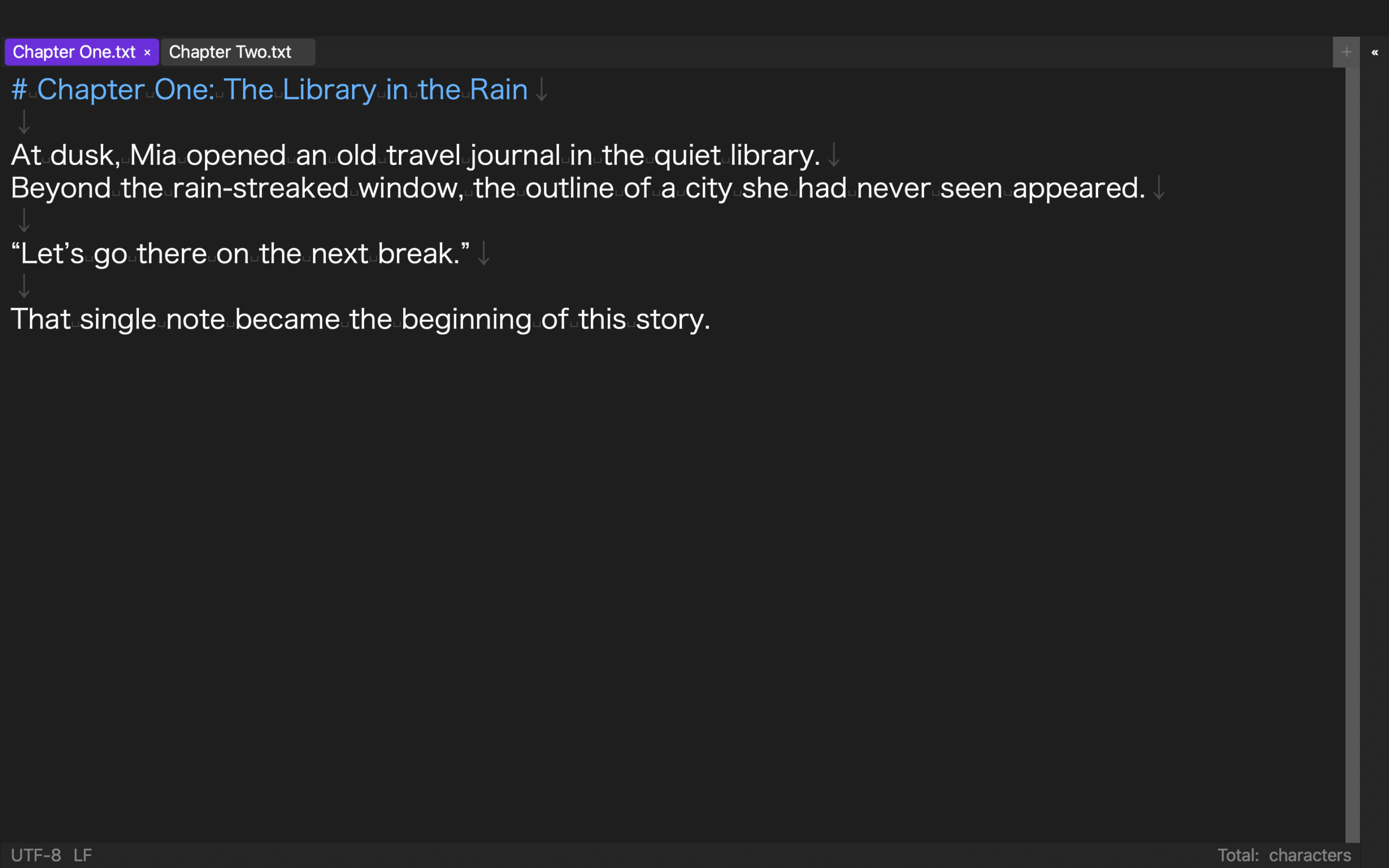
Do not move the production manuscript into a trial. Copy a chapter that resembles normal work in length, headings, ruby annotations, punctuation, and distinctive terms. Copy one character sheet or glossary into a folder explicitly labeled as a trial.
Record the candidate version, macOS version, trial folder, chapter size, and number of references. A note that only says “felt fast” cannot be compared after the conditions change.
For every session, use these columns: start state, task, expected result, actual result, moments of uncertainty, recovery minutes, and authoritative source at the end.
Run five session types twice
Sessions one and six open the trial folder and locate the manuscript and reference. Do not rely only on a recent-items menu. Confirm that the same working environment can be reached from the folder.
Sessions two and seven add one sentence, save, close, and reopen. Search for a distinctive term before and after the change to confirm that the saved form exists in the same source.
Sessions three and eight simulate project-wide search across several copied chapters. Change only one occurrence, then repeat the search. The purpose is not replacement speed; it is the ability to explain the changed scope.
Sessions four and nine compare the chapter with the character sheet. Whether or not split panes are used, record how many actions return to the evidence and whether accidental typing occurs outside the manuscript.
Sessions five and ten close the application and workspace, then reproduce the next day’s start. A candidate can remain usable even if every tab and divider is not restored, provided the authoritative source is recovered quickly. When restoration exists, verify that it restores the correct files rather than merely showing familiar tab names.
Compare the first and second runs
Place the two runs of each type side by side. A shorter second run may show that the workflow stabilized with learning. Extra selection and data entry on the second run can reveal incomplete persistence or a poorly recorded starting state.
A minimum standard candidate keeps the authoritative source intact across all ten sessions, completes the second run of every type, and has an explainable recovery route after mistakes. Do not select by the shortest duration alone.
One incident is not an automatic rejection. A mistaken tab that can be corrected in two minutes with a clear prevention rule may fit ordinary use. A situation that creates two competing manuscript copies with no reliable choice should pause adoption.
Keep convenience separate
Vertical preview, split panes, highlighting, and EPUB generation may be essential for one book and irrelevant for another. Their quantity does not establish a durable standard.
Source location, saved-content verification, search scope, and close/reopen behavior recur in most long projects. Establish those continuity conditions first, then add project-specific conveniences.
Keep price and popularity in separate columns. A cheap editor that consumes recovery time every week can be costly. A popular editor that does not fit the manuscript format or publication exit is not a standard for this project.
Verified core routes in rune Studio
The current Mac version of rune Studio targets macOS 13 or later and treats a folder as a workspace. Existing level-4 verification covered workspace creation, source listing, project search, source location, manual save, and close/reopen.
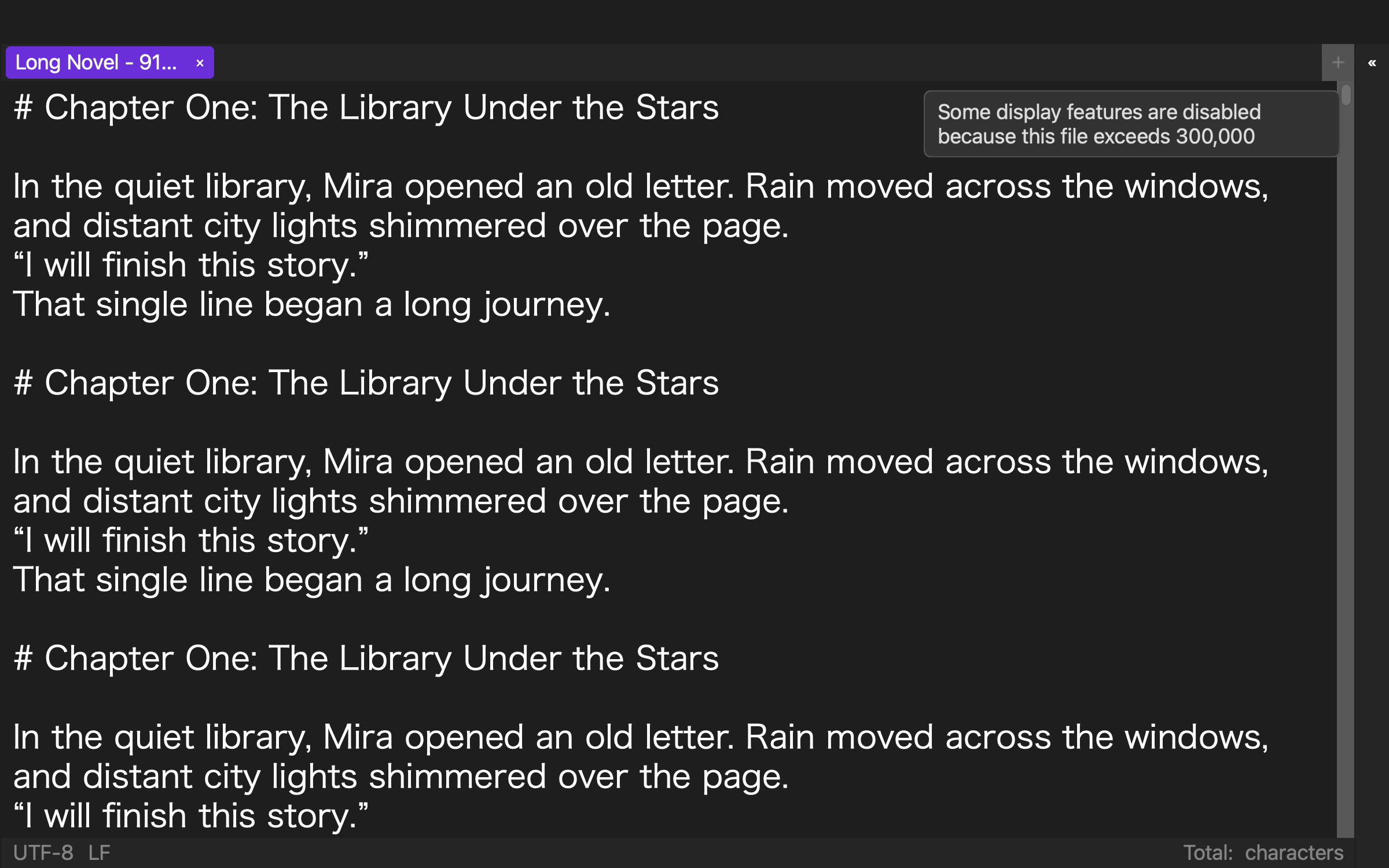
In a 919,514-character test, command-line search, one limited replacement, manual save, another search, and close/reopen completed. The saved file contained 919,517 characters. A separate boundary test returned false at 299,999 characters and true at 300,000 and 300,001. The feature documentation says expensive display processing is disabled at or above the threshold while core operations remain.
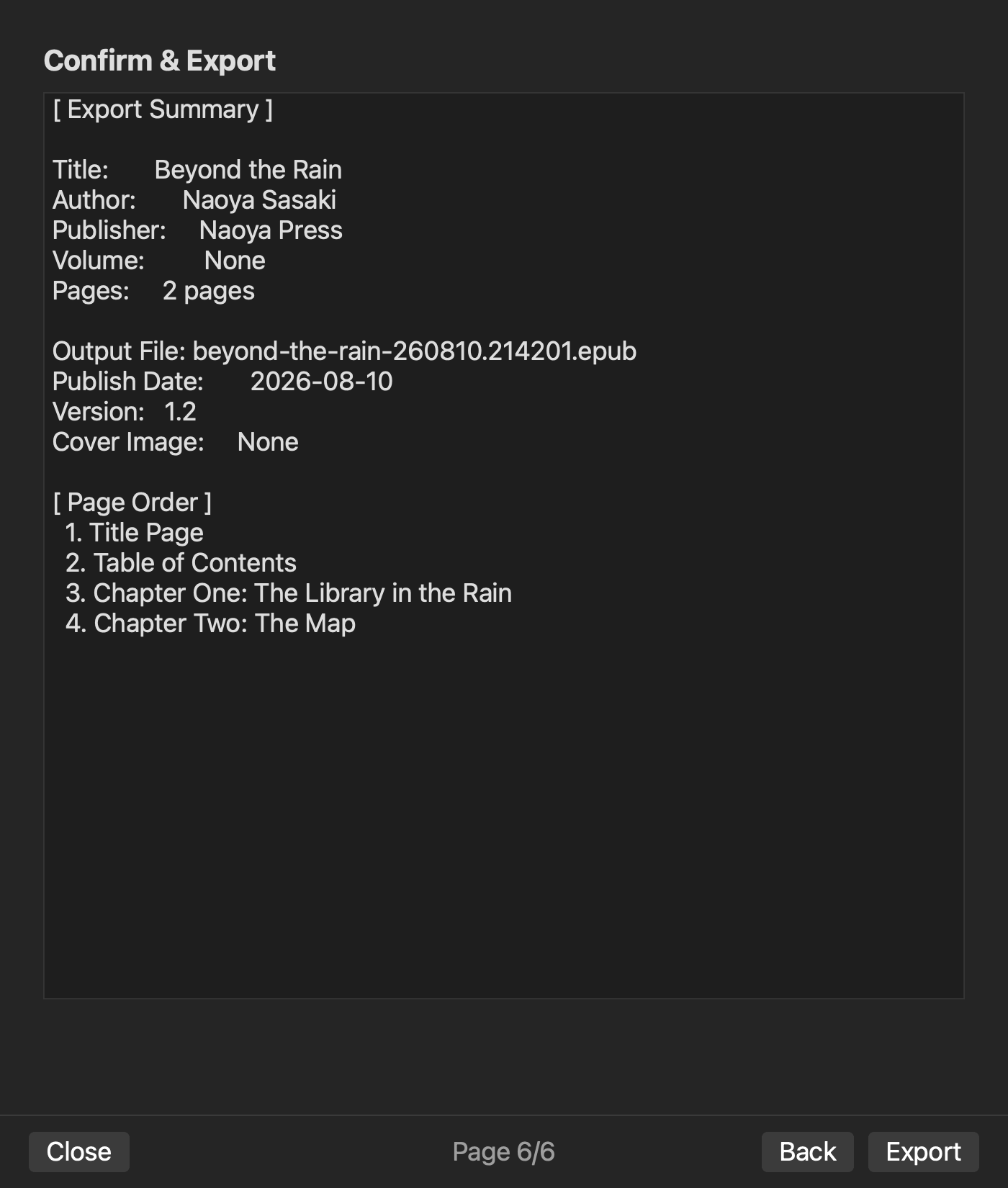
For a publication exit, another level-4 test generated a 5,444-byte EPUB from two files representing two chapters. It contained nav and NCX data and reported zero missing images, leaked notation, empty pages, and issues.
These results verify individual core routes, not ten consecutive GUI sessions. They do not establish IME latency, future macOS support, every long-novel structure, reading-app compatibility, or store acceptance. An author’s ten-session log remains necessary.
Conclusion: make repeatability the standard
Judge a standard Mac text editor through authoritative-source safety, repeatable procedures, and recovery time. Run open, write, search, reference, and reopen sessions twice, and identify the source at the end of all ten.
The best first attempt is less important than a second run that returns to the same correct result. Add convenience features afterward, and pause adoption when the tool produces competing sources that cannot be reconciled. That turns “standard” from a reputation into evidence from daily long-form work.