
The best text editor for a long novel depends on the project. Before consulting popularity rankings or counting features, measure the manuscript’s total size, number of chapters, reference load, interruption and update frequency, and publication exit. Those five facts can become observable requirements that reveal what the novel actually needs.
The result of this article is not a winner, a pass/fail product screen, or a scored comparison. It is a requirement sheet divided into must-have, preferred, and deferred items. The seven-condition candidate screen in STUDIO-002, the five-trial comparison in STUDIO-025, and the post-selection environment setup in STUDIO-032 happen later.
Measure five facts about the project
First, record the current total character count, the estimated count at completion, and the size of the longest chapter file. A 300,000-character book held in one file creates a different load from the same book split into forty chapter files. The label “long novel” is too vague to use as a product requirement.
Second, count the chapters and estimate how often their order changes. A nonlinear draft that is reorganized every week needs a stronger chapter-level view than a project whose sequence becomes stable early.
Third, list the reference categories used while writing: characters, terminology, timeline, locations, research notes, and images. Note whether each reference must remain visible beside the draft or merely needs to be searchable.
Fourth, measure how the work is interrupted. Record how often the Mac is closed, how often you return to an earlier chapter, and how many short sessions occur in a typical week. An author who writes for one hour every day pays a higher cost for a poor reopen route than someone who works in long uninterrupted sessions.
Fifth, decide where the finished manuscript goes. It might be delivered as text or DOCX, posted to a web serial, or generated as an EPUB. The required exit should follow the book’s actual publication plan.
Convert facts into failure scenarios
Do not translate each measurement directly into a feature name. Write one sentence describing what fails without the capability.
For a very large manuscript, the failure might be: “When optional display processing becomes expensive, body editing, search, and saving stop as well.” The requirement is not merely “fast.” It is: “At the representative manuscript size, core editing operations remain available, and the boundary between core operations and disabled display aids can be explained.”
For a large chapter count, the failure might be: “Splitting the book into chapter files makes project-wide consistency searches incomplete.” The requirement becomes: “The editor can work on individual chapters while searching the same authoritative set as a whole.” Having many tabs is not enough.
For a reference-heavy project, the failure might be: “The author repeatedly leaves the draft to rediscover the evidence for a character or setting decision.” A more useful requirement is: “The locations of draft and reference files are visible in one workspace, and the required material can be viewed or searched without creating another authoritative copy.”
Write requirements as observable behavior
Avoid adjectives such as easy, powerful, fast, or suitable for novels. Replace them with statements that can later be observed with a copy of the project:
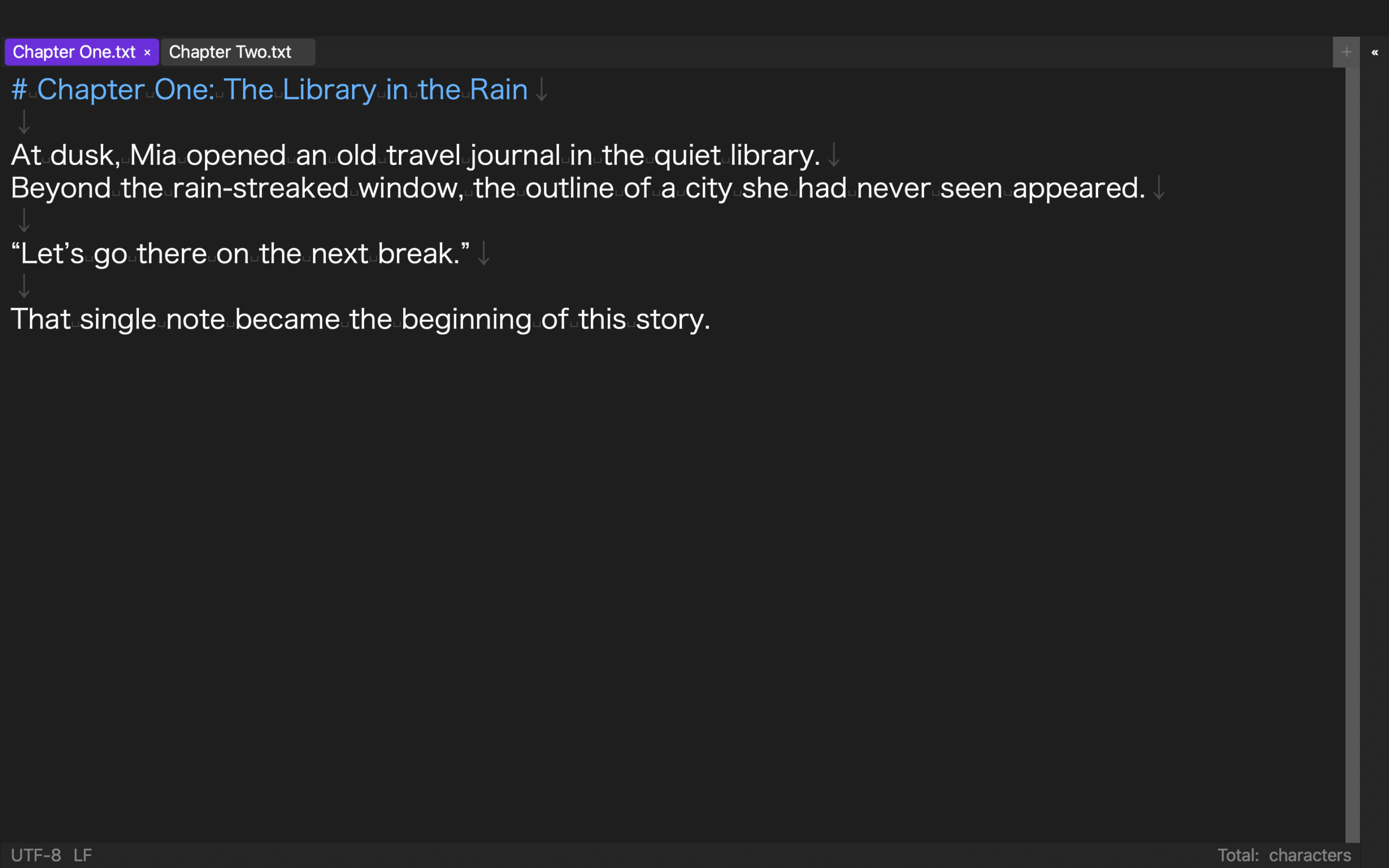
- It opens a representative chapter and a copy at the projected total scale.
- It searches for a distinctive term across the authoritative project.
- It changes one sentence, saves it, and finds the saved form in a second search.
- After closing and reopening, the author can identify the authoritative manuscript and references.
- The same authoritative source can reach the required publication handoff.
Do not run candidates and assign pass marks yet. Completing these statements is the boundary of this stage. They become inputs for later screening and comparative trials.
Prioritize by frequency and recovery cost
For every requirement, record how often the related event occurs and how long recovery would take after failure. An event that occurs several times a week and can cause the authoritative source to be lost belongs in must-have. A daily convenience with a safe workaround may be preferred. A function used once near publication and safely delegated to another tool may be deferred.
Project-wide search is a must-have for an author who revisits chapters every day. Split panes may be preferred or deferred for an author who can retrieve references quickly with search. Vertical preview does not need to be mandatory for a horizontally published book.
The publication exit follows the same rule. A weekly EPUB release makes repeatable generation close to essential. If one final manuscript will be handed to a production specialist, a safe standard handoff can matter more than an integrated EPUB generator.
Build one requirements sheet
Use five columns: project fact, failure scenario, observable action, priority, and safe alternative. Leave product names and scores out of the sheet.
Writing product names too early encourages you to reshape the novel around familiar features. A product-neutral sheet shows whether a missing function is truly unacceptable and whether a large feature set would add unnecessary cost or learning time.
Long novels change during production, so revisit the sheet at three points: halfway through the first draft, at draft completion, and when revision begins. A requirement may move between preferred and must-have. The recorded fact and failure scenario preserve the reason for the change.
Map rune Studio to the requirements
The current Mac version of rune Studio treats a folder as a workspace for manuscripts and references. Its feature documentation includes a file tree, split panes, and saved purpose-specific layouts. Those documented functions are potential matches for requirements derived from reference volume and viewing needs.
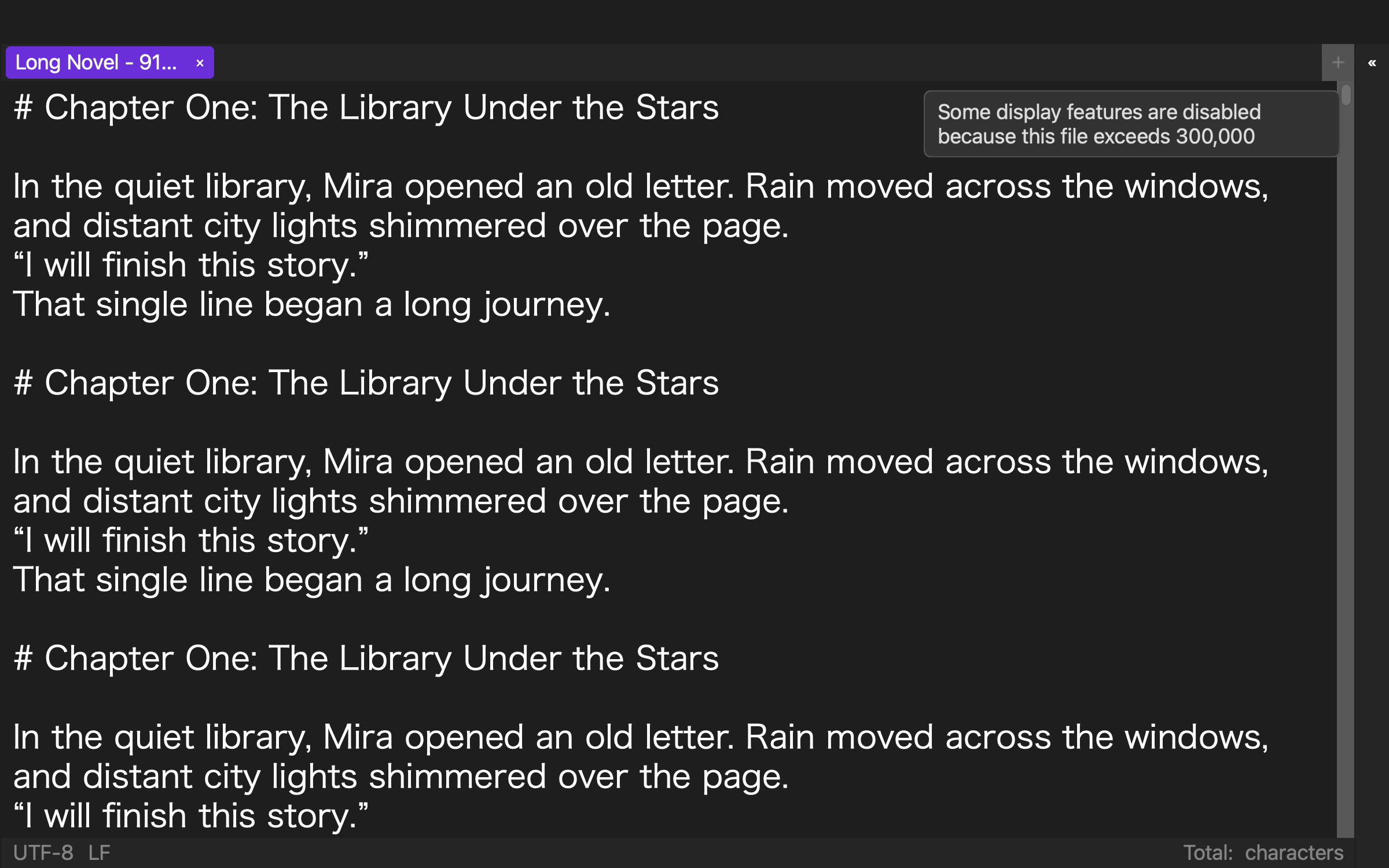
In an existing level-4 test, a 919,514-character manuscript was searched, one occurrence was replaced, the file was manually saved, the result was searched again, and the workspace was then closed and reopened. The saved file contained 919,517 characters. A separate threshold test reported the large-file condition as false at 299,999 characters and true at 300,000 and 300,001. The documentation states that files at or above 300,000 characters disable expensive display processing while retaining core operations such as search and save.
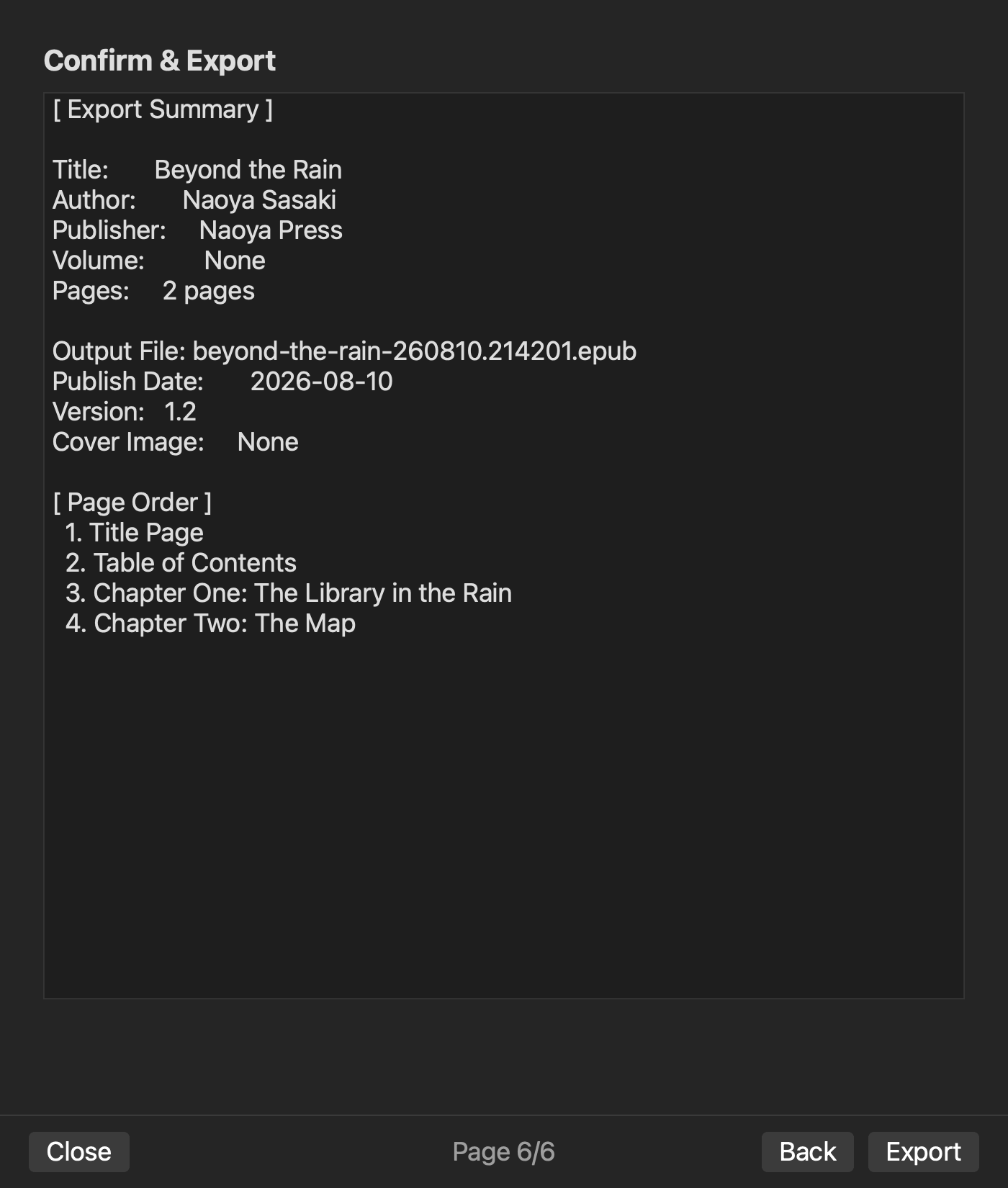
For a publication exit, another level-4 test generated a 5,444-byte EPUB from two files representing two chapters. The result contained nav and NCX data and reported zero missing images, leaked notation, empty pages, and issues. That is a result under the tested conditions; it does not establish a cover-bearing workflow, reading-app compatibility, or store acceptance.
The file tree, split panes, saved layouts, and the documented list of disabled display aids are level-2 evidence from the current feature description. This article does not claim tested GUI responsiveness, IME latency, or universal suitability for every Mac and long-novel structure.
Conclusion: specify the novel before ranking editors
To choose a text editor for a long novel, measure total size, chapter count, reference load, resume frequency, and publication exit. Turn each fact into a failure scenario and an observable action, then prioritize it by frequency and recovery cost.
This requirement sheet gives the later screening and comparison stages a project-specific standard. Instead of beginning with the most popular editor, begin with the conditions under which this particular novel can continue safely from drafting through its intended handoff.